
Calorie guide · International
Chicken wrapcalories and macros
One serving of Chicken wrap has about 480 kcal, with 34 g protein, 46 g carbohydrates and 16 g fat. That is roughly 29% of calories from protein, 40% from carbs and 31% from fat.
Where the calories come from
- Protein34 g29%
- Carbs46 g40%
- Fat16 g31%
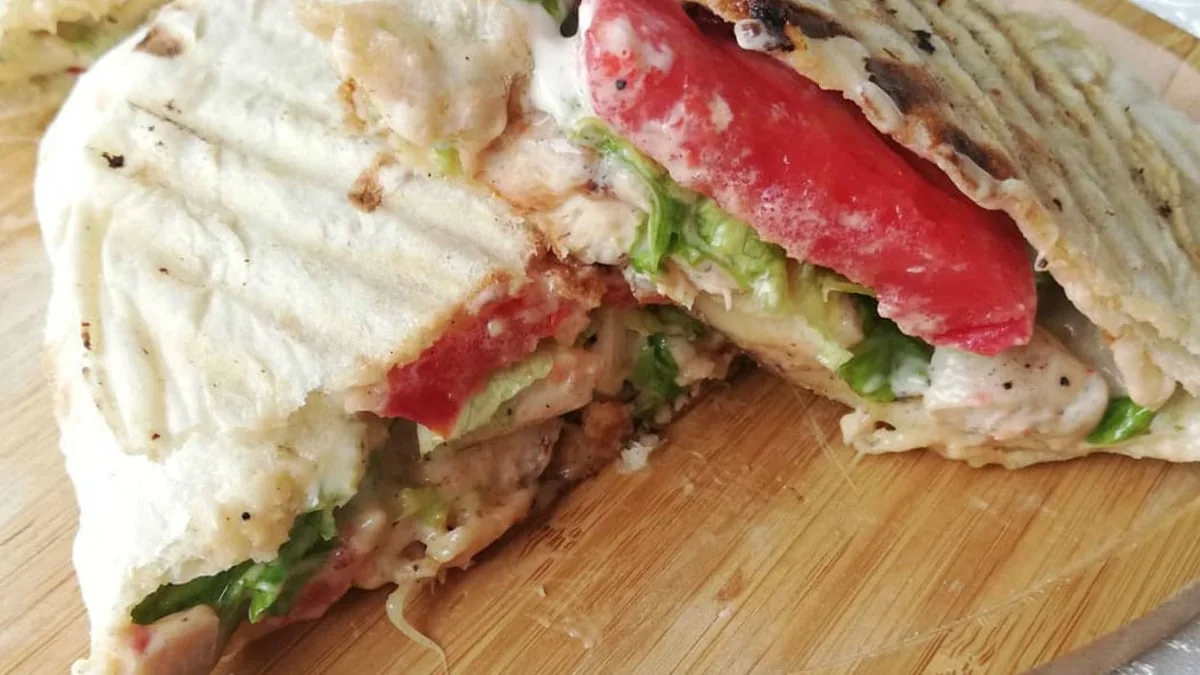
This lunch wraps 130 g of grilled chicken breast in a large wheat tortilla with lettuce, tomato, cucumber, red onion and a yogurt sauce. A serving is roughly 480 kcal with 34 g of protein and 46 g of carbohydrates, most of them from the tortilla, while 16 g of fat provides about 30% of the calories.
Nutrition per serving
| Nutrient | Per 100 g | 1 serving (~330 g) | Share of calories |
|---|---|---|---|
| Calories | 145 kcal | 480 kcal | 100% |
| Protein | 10.3 g | 34 g | 29% |
| Carbs | 13.9 g | 46 g | 40% |
| Fat | 4.8 g | 16 g | 31% |
How many calories in 100 g of Chicken wrap?
A typical serving of Chicken wrap weighs about 330 g, so 100 g has about 145 kcal, 10.3 g protein, 13.9 g carbohydrates and 4.8 g fat.
Calories for your portion
Calories by amount
| Amount | Weight | kcal | Protein | Carbs | Fat |
|---|---|---|---|---|---|
| ½ serving | 165 g | 240 | 17 g | 23 g | 8 g |
| 1 serving | 330 g | 480 | 34 g | 46 g | 16 g |
| 1½ servings | 495 g | 720 | 51 g | 69 g | 24 g |
| 2 servings | 660 g | 960 | 68 g | 92 g | 32 g |
| 100 g | 100 g | 145 | 10.3 g | 13.9 g | 4.8 g |
| 200 g | 200 g | 291 | 20.6 g | 27.9 g | 9.7 g |
Vitamins and minerals in Chicken wrap
Per serving, with the share of the daily value (DV) used on US nutrition labels.
| Nutrient | Per serving | % DV |
|---|---|---|
| Fiber | 3.9 g | 14% |
| Sugars | 6.9 g | – |
| Saturated fat | 3.7 g | 19% |
| Sodium | 830 mg | 36% |
| Potassium | 815 mg | 17% |
| Calcium | 175 mg | 13% |
| Iron | 3 mg | 17% |
| Vitamin C | 10 mg | 11% |
| Vitamin A | 80 µg | 9% |
| Vitamin D | 0.1 µg | 1% |
| Vitamin B12 | 0.4 µg | 17% |
Allergens in Chicken wrap
- Gluten
- Milk
A typical recipe contains the allergens below (EU list of 14). Recipes, sauces and kitchens differ, so always check the label or ask when you eat out.
Which diets does Chicken wrap fit?
Based on the ingredients of a typical serving. Recipes vary, so check labels if you have an allergy or follow a diet strictly.
How long would you walk to burn a serving of Chicken wrap?
For a 70 kg adult, the 480 kcal in one serving is about 112 minutes of comfortable walking or 82 minutes of brisk walking. This is only a rough perspective: food is not something you have to earn or burn off, and the numbers change with body size.
| Comfortable walk (about 4 km/h) | 112 min |
| Brisk walk (about 5.5 km/h) | 82 min |
Work it out for your own weight and activity with the calories burned calculator.
What's in a typical serving
A tortilla filled with grilled chicken, crunchy vegetables and yogurt sauce, a portable lunch high in protein.
- 130g Grilled Chicken Breast
- Large Wheat Tortilla
- Lettuce, Tomato, Cucumber
- Yogurt Sauce
- Red Onion
How to make it
- Season 130 g chicken breast with salt, pepper and paprika.
- Grill it in a hot grill pan for 5 to 6 minutes per side until cooked through, then rest 2 minutes and slice.
- Shred the lettuce, slice the tomato and cucumber, and thinly slice the red onion.
- Warm the large wheat tortilla in a dry pan for a few seconds per side.
- Spread the yogurt sauce over the tortilla, then add the vegetables and the sliced chicken.
- Fold in the sides, roll up tightly and cut in half to serve.
Rate this recipe
No ratings yet — be the first.
Made it, or tried it? Tap a star — your rating helps other readers.
How to make it lighter
- Large tortillas vary a lot in size, so check the label: the wrap itself can be a big share of the calories.
- Stick with a yogurt-based sauce rather than mayonnaise or cheese sauce.
- Pack in extra lettuce, cucumber and tomato for volume without adding many calories.
Lighter alternatives
More International dishes
Work out your own daily calorie target with the calorie calculator.
Frequently asked questions
How many calories are in Chicken wrap?
A typical serving of Chicken wrap has about 480 kcal. The exact number depends on the recipe, the amount of oil or butter and the portion size.
How many calories are in 100 g of Chicken wrap?
About 145 kcal. That is based on a typical serving of about 330 g with 480 kcal; the real figure changes with the recipe and how much oil is used.
Is Chicken wrap high in protein?
Yes. With about 34 g of protein per serving (29% of its calories), Chicken wrap is a good protein source.
Can I eat Chicken wrap while losing weight?
Yes, if it fits your daily calorie target. Weight loss depends on your total intake over time, not on a single dish; portion size and added fats make the biggest difference.
How long do you have to walk to burn off Chicken wrap?
Roughly 112 minutes of comfortable walking for a 70 kg adult, or about 82 minutes at a brisk pace. Treat it as a perspective only; it depends on body size and you do not need to 'burn off' food.
Is Chicken wrap vegetarian?
No. A typical serving of Chicken wrap contains meat or fish.
Is Chicken wrap gluten-free?
Usually not. A typical serving contains wheat or another gluten source.
How can I make Chicken wrap lighter?
Large tortillas vary a lot in size, so check the label: the wrap itself can be a big share of the calories. Stick with a yogurt-based sauce rather than mayonnaise or cheese sauce. Pack in extra lettuce, cucumber and tomato for volume without adding many calories.
How we calculated these values
- Calories and macros are Sporty catalog estimates for one typical serving, calculated from USDA FoodData Central values for the listed ingredient amounts.
- The serving weight (330 g) is estimated from those ingredients; the per-100 g values and the portion calculator are worked out from it.
- Walking times use the Compendium of Physical Activities: 3.5 MET for comfortable and 4.8 MET for brisk walking, for a 70 kg adult (kcal per minute = MET × 3.5 × kg ÷ 200).
- Vitamins, minerals and allergens are estimated from the same ingredients with USDA FoodData Central values; % DV uses the US FDA daily values.
- Diet labels come from the ingredients. Real values change with the recipe, the amount of oil and the portion, so treat every number as an estimate.