
Calorie guide · Turkish
Shrimp casserole (karides güveç)calories and macros
One serving of Shrimp casserole (karides güveç) has about 380 kcal, with 30 g protein, 10 g carbohydrates and 24 g fat. That is roughly 32% of calories from protein, 11% from carbs and 57% from fat.
Where the calories come from
- Protein30 g32%
- Carbs10 g11%
- Fat24 g57%
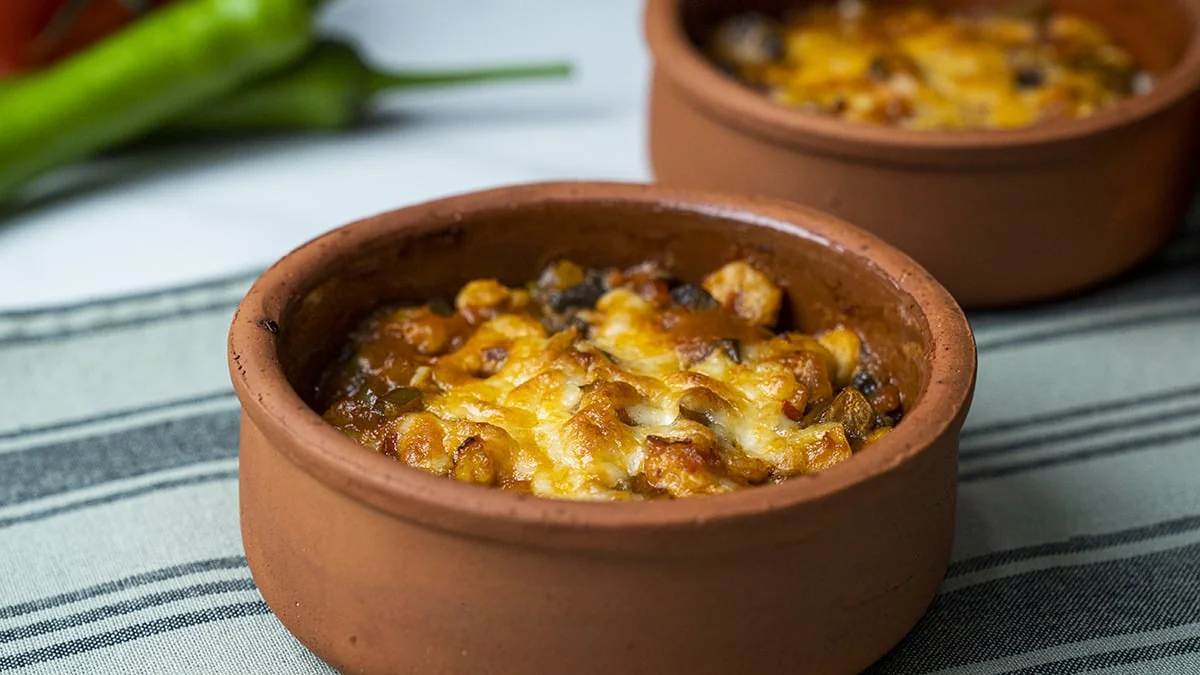
Karides güveç is a Turkish meze of 180 g of shrimp baked in a small clay pot with tomato, green pepper, garlic and 1 tbsp of butter under 30 g of melted kaşar, a mild Turkish cheese. A serving is roughly 380 kcal with 30 g of protein and only 10 g of carbohydrates, and about 57% of the calories come from its 24 g of fat, mainly the butter and cheese.
Nutrition per serving
| Nutrient | Per 100 g | 1 serving (~300 g) | Share of calories |
|---|---|---|---|
| Calories | 127 kcal | 380 kcal | 100% |
| Protein | 10 g | 30 g | 32% |
| Carbs | 3.3 g | 10 g | 11% |
| Fat | 8 g | 24 g | 57% |
How many calories in 100 g of Shrimp casserole (karides güveç)?
A typical serving of Shrimp casserole (karides güveç) weighs about 300 g, so 100 g has about 127 kcal, 10 g protein, 3.3 g carbohydrates and 8 g fat.
Calories for your portion
Calories by amount
| Amount | Weight | kcal | Protein | Carbs | Fat |
|---|---|---|---|---|---|
| ½ serving | 150 g | 190 | 15 g | 5 g | 12 g |
| 1 serving | 300 g | 380 | 30 g | 10 g | 24 g |
| 1½ servings | 450 g | 570 | 45 g | 15 g | 36 g |
| 2 servings | 600 g | 760 | 60 g | 20 g | 48 g |
| 100 g | 100 g | 127 | 10 g | 3.3 g | 8 g |
| 200 g | 200 g | 253 | 20 g | 6.7 g | 16 g |
Vitamins and minerals in Shrimp casserole (karides güveç)
Per serving, with the share of the daily value (DV) used on US nutrition labels.
| Nutrient | Per serving | % DV |
|---|---|---|
| Fiber | 2 g | 7% |
| Sugars | 5 g | – |
| Saturated fat | 13.3 g | 67% |
| Sodium | 920 mg | 40% |
| Potassium | 650 mg | 14% |
| Calcium | 340 mg | 26% |
| Iron | 0.9 mg | 5% |
| Vitamin C | 45 mg | 50% |
| Vitamin A | 215 µg | 24% |
| Vitamin D | 0.2 µg | 1% |
| Vitamin B12 | 2.3 µg | 96% |
Allergens in Shrimp casserole (karides güveç)
- Crustaceans
- Milk
A typical recipe contains the allergens below (EU list of 14). Recipes, sauces and kitchens differ, so always check the label or ask when you eat out.
Which diets does Shrimp casserole (karides güveç) fit?
Based on the ingredients of a typical serving. Recipes vary, so check labels if you have an allergy or follow a diet strictly.
How long would you walk to burn a serving of Shrimp casserole (karides güveç)?
For a 70 kg adult, the 380 kcal in one serving is about 89 minutes of comfortable walking or 65 minutes of brisk walking. This is only a rough perspective: food is not something you have to earn or burn off, and the numbers change with body size.
| Comfortable walk (about 4 km/h) | 89 min |
| Brisk walk (about 5.5 km/h) | 65 min |
Work it out for your own weight and activity with the calories burned calculator.
What's in a typical serving
Shrimp baked in a clay pot with tomato, peppers and garlic under a bubbling layer of melted cheese.
- 180g Shrimp
- 30g Kaşar Cheese
- Tomato, Green Pepper, Garlic
- 1 tbsp Butter
How to make it
- Heat the oven to 200°C.
- Melt 1 tbsp of butter in a pan and sauté a chopped green pepper and 2 sliced garlic cloves for 2 minutes.
- Add a grated tomato and cook for 3 to 4 minutes until slightly thickened.
- Stir in 180 g of cleaned shrimp, season with salt and pepper, and transfer to a small clay pot.
- Top with 30 g of grated kaşar cheese.
- Bake for 10 to 12 minutes until the cheese is melted and golden and the shrimp are pink and opaque.
Rate this recipe
No ratings yet — be the first.
Made it, or tried it? Tap a star — your rating helps other readers.
How to make it lighter
- Use half the butter or swap it for a teaspoon of olive oil; the tomatoes keep the shrimp moist.
- Grate a thinner layer of cheese on top, or use a lighter cheese.
- Count the bread used to mop up the buttery sauce separately, or use a salad instead.
Lighter alternatives
More Turkish dishes
Work out your own daily calorie target with the calorie calculator.
Frequently asked questions
How many calories are in Shrimp casserole (karides güveç)?
A typical serving of Shrimp casserole (karides güveç) has about 380 kcal. The exact number depends on the recipe, the amount of oil or butter and the portion size.
How many calories are in 100 g of Shrimp casserole (karides güveç)?
About 127 kcal. That is based on a typical serving of about 300 g with 380 kcal; the real figure changes with the recipe and how much oil is used.
Is Shrimp casserole (karides güveç) high in protein?
Yes. With about 30 g of protein per serving (32% of its calories), Shrimp casserole (karides güveç) is a good protein source.
Can I eat Shrimp casserole (karides güveç) while losing weight?
Yes, if it fits your daily calorie target. Weight loss depends on your total intake over time, not on a single dish; portion size and added fats make the biggest difference.
How long do you have to walk to burn off Shrimp casserole (karides güveç)?
Roughly 89 minutes of comfortable walking for a 70 kg adult, or about 65 minutes at a brisk pace. Treat it as a perspective only; it depends on body size and you do not need to 'burn off' food.
Is Shrimp casserole (karides güveç) vegetarian?
No. A typical serving of Shrimp casserole (karides güveç) contains meat or fish.
Is Shrimp casserole (karides güveç) gluten-free?
A typical serving is made without gluten-containing ingredients. If you have coeliac disease, check every label for cross-contamination.
How can I make Shrimp casserole (karides güveç) lighter?
Use half the butter or swap it for a teaspoon of olive oil; the tomatoes keep the shrimp moist. Grate a thinner layer of cheese on top, or use a lighter cheese. Count the bread used to mop up the buttery sauce separately, or use a salad instead.
How we calculated these values
- Calories and macros are Sporty catalog estimates for one typical serving, calculated from USDA FoodData Central values for the listed ingredient amounts.
- The serving weight (300 g) is estimated from those ingredients; the per-100 g values and the portion calculator are worked out from it.
- Walking times use the Compendium of Physical Activities: 3.5 MET for comfortable and 4.8 MET for brisk walking, for a 70 kg adult (kcal per minute = MET × 3.5 × kg ÷ 200).
- Vitamins, minerals and allergens are estimated from the same ingredients with USDA FoodData Central values; % DV uses the US FDA daily values.
- Diet labels come from the ingredients. Real values change with the recipe, the amount of oil and the portion, so treat every number as an estimate.