

A small handful of nuts or seeds (about 28 g) has roughly 135–185 kcal, mostly from fat, according to USDA data. Despite that, a 2021 meta-analysis of randomised trials found that eating nuts did not increase body weight. The key is a measured portion: about 28–30 g as a snack, or 10–15 g as a topping.
Key takeaways
- 28 g of nuts or seeds gives about 135–185 kcal; the amount matters more than the type.
- A 2021 meta-analysis of more than 80 trials found nut-containing diets did not increase body weight.
- Pumpkin seeds and peanuts have the most protein; chia and flax the most fibre.
- Use about 28–30 g as a snack or 10–15 g as a topping, and log every portion.
- Salted and coated nuts add sodium or sugar; plain raw or dry-roasted nuts are easiest to fit in.
Are nuts and seeds fattening?
Nuts and seeds are among the most calorie-dense foods you can eat: most contain around 550–650 kcal per 100 g, mainly from fat. That sounds like bad news for weight loss, but the research is more reassuring than the numbers suggest.
A 2021 systematic review and meta-analysis in Obesity Reviews pooled more than 80 randomised trials and found that diets including nuts did not increase body weight compared with control diets (an average difference of about 0.09 kg, which was not significant), with the certainty of that evidence rated high. In cohort studies of more than half a million people, higher nut intake was linked to a slightly lower risk of overweight or obesity, though observational data like these cannot prove cause and effect.
Part of the explanation may be that not all of the energy in whole nuts is absorbed. In a 2012 USDA feeding study with 18 adults, almonds provided about 129 kcal per 28 g serving, against the 168–170 kcal predicted by the standard calculation, an overestimate of about 32 %. Results for other nuts and for nut butters may differ, and the label is still the number to log. The practical message: nuts fit a weight-loss diet well, as long as the portion is a choice rather than an accident.
How many calories are in a handful of nuts and seeds?
A small handful of nuts weighs roughly 28–30 g. Here are values for 28 g of raw, unsalted nuts and dried seeds, calculated from USDA FoodData Central:
| 28 g of… | kcal | Protein | Fat | Fibre |
|---|---|---|---|---|
| Chia seeds | 136 | 4.6 g | 8.6 g | 9.6 g |
| Flaxseed | 150 | 5.1 g | 11.8 g | 7.6 g |
| Cashews | 155 | 5.1 g | 12.3 g | 0.9 g |
| Pistachios | 157 | 5.7 g | 12.7 g | 3.0 g |
| Pumpkin seeds | 157 | 8.5 g | 13.7 g | 1.7 g |
| Peanuts | 159 | 7.2 g | 13.8 g | 2.4 g |
| Almonds | 162 | 5.9 g | 14.0 g | 3.5 g |
| Sunflower seeds | 164 | 5.8 g | 14.4 g | 2.4 g |
| Hazelnuts | 176 | 4.2 g | 17.0 g | 2.7 g |
| Walnuts | 183 | 4.3 g | 18.3 g | 1.9 g |
Two things stand out. First, the calorie range is narrow: any handful lands between about 135 and 185 kcal, so the type of nut matters less than the amount. Second, the extras differ. Pumpkin seeds and peanuts (botanically a legume) bring the most protein, chia and flax the most fibre, and walnuts and hazelnuts the most fat. Nuts are not a protein food in the way chicken, yogurt or lentils are: even pumpkin seeds give only about 5 g of protein per 100 kcal.
What is a smart portion when you are losing weight?
- As a snack: about 28–30 g, or a small handful, for roughly 140–180 kcal. Pair it with fruit or yogurt for more volume; our list of snacks under 200 calories has more ideas.
- As a topping: 10–15 g on yogurt, salad or oats adds crunch for about 50–100 kcal.
- Nut butter: USDA lists smooth peanut butter at about 598 kcal per 100 g, so a heaped 16 g tablespoon is close to 100 kcal. Two generous spoonfuls on toast can easily reach 200 kcal before the bread.
Without a scale, a cupped palm of nuts is a reasonable stand-in for a small handful; our guide to portion sizes without a scale explains how to use your hand. Weighing your usual handful once is worth it, because it is easy to underestimate.
How do nuts and seeds show up in real meals?
Several dishes in our catalog get a good share of their calories from nuts or seeds. These are per-serving estimates and real values depend on recipe and portion:
- Walnut tomato salad (gavurdağı): 25 g of walnuts with tomatoes, onion, pomegranate molasses and olive oil, about 260 kcal and 21 g of fat.
- Cottage cheese and walnut fruit bowl: just three walnuts on 150 g of cottage cheese with strawberries, about 280 kcal and 26 g of protein.
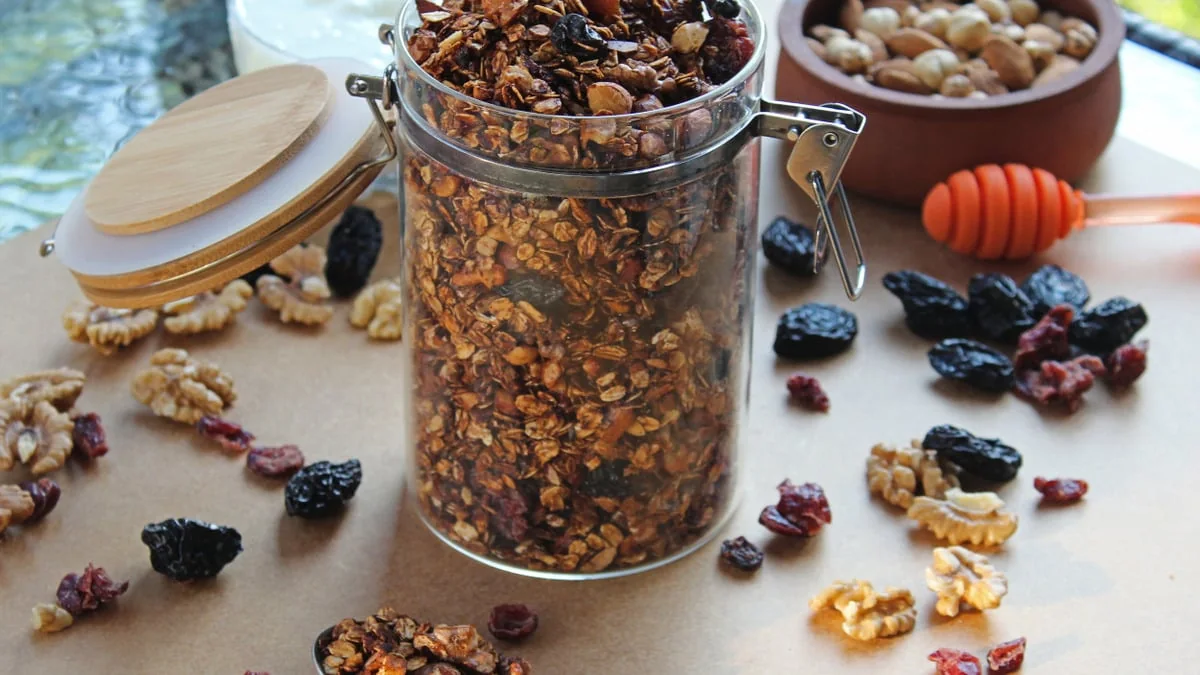
- Homemade granola with yogurt: 50 g of granola with walnuts and almonds, plus honey and fruit, about 420 kcal.
- Chia pudding: 30 g of chia seeds in 200 ml of milk with berries and honey, about 300 kcal.
The cottage cheese bowl shows how to use nuts well in a deficit: a small amount for flavour and texture on top of a protein-rich base.
Which nut or seed suits which goal?
- More protein: pumpkin seeds (8.5 g per 28 g) and peanuts (7.2 g).
- More fibre: chia (9.6 g per 28 g) and flaxseed (7.6 g), which also thicken yogurt or oats when soaked.
- Fewest calories per handful: chia, flaxseed, cashews and pistachios, all at about 136–157 kcal per 28 g.
- Most flavour from a small amount: walnuts and hazelnuts, which are the densest, so a few go a long way in salads and breakfasts.
Does it matter if nuts are roasted, salted or coated?
Roasting changes calories only a little. USDA lists raw almonds at 579 kcal per 100 g, dry-roasted at 598 and oil-roasted at 607. Salt is the bigger difference: dry-roasted salted almonds have about 234 mg of sodium per 100 g, against about 1 mg for raw ones. Honey-roasted, sugar-coated and chocolate-covered nuts add sugar and usually come in bigger portions. Plain raw or dry-roasted nuts are the easiest to fit in, and in-shell pistachios or walnuts take longer to eat than a bag of shelled ones.
Why keep nuts and seeds in your diet at all?
The WHO lists nuts among the foods of a healthy diet and recommends that most fat should come from unsaturated sources, such as nuts and olive oil, rather than saturated fats. Nuts and seeds also bring fibre, vitamin E and minerals such as magnesium. For the bigger picture on fat, see how much fat you should eat.
Nut and seed allergies can be serious. If you have a known allergy, avoid the foods involved and follow your doctor's advice; if you suspect one, get it checked rather than testing at home. Whole nuts are also a choking risk for young children.
How do you log nuts accurately?
Nuts are one of the easiest foods to under-log, because a few here and there do not feel like a meal. Log them every time, even as a topping, and weigh the first few portions so your estimates improve. In Sporty you can scan the barcode of a packet or describe the amount in words, for example "30 g almonds", and the calories are added to your day.
Frequently asked questions
How many almonds are in 28 g?
Usually around 20–24, depending on size. Weigh your usual handful once to see what it looks like.
Which nut has the fewest calories?
Among common raw nuts in USDA data, cashews and pistachios are at the lower end (about 155–157 kcal per 28 g) and walnuts the highest (about 183 kcal). The difference is small compared with portion size.
Can I eat nuts every day while losing weight?
Yes, most people can, as long as you count them. A daily small handful fits easily into most calorie targets and brings healthy fats and fibre.
Are nut butters as good as whole nuts?
They have similar nutrients, but they are easy to over-pour. A heaped tablespoon of peanut butter is close to 100 kcal, so measure it and choose versions without added sugar.
Was this article helpful?
No ratings yet — be the first.
Tap a star to rate it — your rating helps us improve and helps other readers.
Sources
- USDA FoodData Central (SR Legacy: raw nuts and dried seeds)
- Nishi et al. 2021, Are fatty nuts a weighty concern? Systematic review and meta-analysis of prospective cohorts and randomized controlled trials (Obesity Reviews)
- Novotny et al. 2012, Discrepancy between the Atwater factor predicted and empirically measured energy values of almonds in human diets (Am J Clin Nutr, 18 adults)
- WHO, Healthy diet fact sheet
This article is general information, not medical advice. If you have a health condition, are pregnant or under 18, talk to a doctor or registered dietitian before changing your diet.