
Most adults should get 20–35% of their daily calories from fat, which is about 44–78 g on a 2,000 kcal diet. The WHO suggests keeping total fat at 30% or less, saturated fat below 10% of calories, and avoiding industrial trans fats, with most fat coming from unsaturated sources such as fish, nuts, avocado and vegetable oils.
Key takeaways
- Fat is essential: it supplies essential fatty acids and helps you absorb vitamins A, D, E and K.
- Aim for 20–35% of calories from fat; on 1,800 kcal that is roughly 40–70 g a day.
- Keep saturated fat below 10% of calories and avoid industrially produced trans fats.
- Fat has 9 kcal per gram, so every extra 10 g of oil or butter adds about 90 kcal.
- Lean towards unsaturated sources such as olive oil, fish, nuts, seeds and avocado.
Why does your body need fat?
Fat has a reputation problem, but it is an essential nutrient. Your body uses dietary fat to build cell membranes and hormones, to supply essential fatty acids it cannot make on its own, and to absorb the fat-soluble vitamins A, D, E and K. Fat also slows digestion a little, which helps meals feel satisfying and keeps you full for longer.
The catch is energy density. Fat provides 9 kcal per gram, compared with 4 kcal per gram for protein and carbohydrates. That single fact explains most of the confusion around fat: it is necessary and useful, yet small amounts add a lot of calories. Our guide to macros explained covers how fat fits next to protein and carbs.
How much fat should you eat per day?
For adults, the US National Academies set an Acceptable Macronutrient Distribution Range (AMDR) of 20–35 % of total calories from fat. The World Health Organization (WHO) gives a similar picture from the other side: at least 15 % of daily energy from fat, and total fat at 30 % or less of energy to help prevent unhealthy weight gain.
To turn a percentage into grams, multiply your daily calories by the percentage and divide by 9. Here is what that looks like at common calorie levels:
| Daily calories | Fat at 20 % | Fat at 30 % | Fat at 35 % | Saturated fat limit (10 %) |
|---|---|---|---|---|
| 1,500 kcal | 33 g | 50 g | 58 g | under 17 g |
| 1,800 kcal | 40 g | 60 g | 70 g | under 20 g |
| 2,000 kcal | 44 g | 67 g | 78 g | under 22 g |
| 2,500 kcal | 56 g | 83 g | 97 g | under 28 g |
Example: on 1,800 kcal a day, 30 % from fat is 540 kcal, and 540 ÷ 9 = 60 g. Anything from about 40 g to 70 g sits inside the AMDR. There is no need to hit an exact number; a range you land in most days is enough. If you are not sure what your calorie level is, a calorie calculation based on your size and activity is the place to start; the guide on how many calories to eat to lose weight walks through the calculation.
Which fats count as "healthy fats"?
Total fat is only half the story. The type of fat matters for heart health, and dietary guidance is consistent about the direction to shift:
- Unsaturated fats (monounsaturated and polyunsaturated) are the ones to make up most of your intake. The WHO lists fish, avocado, nuts, and sunflower, soybean, canola and olive oils as sources. Oily fish such as salmon also supply omega-3 fatty acids.
- Saturated fats, found mainly in fatty meat, butter, cheese, cream, and coconut and palm oil, are fine in moderate amounts. Both the WHO and the Dietary Guidelines for Americans advise keeping them below 10 % of total calories.
- Industrially produced trans fats, which can appear in some fried foods, baked goods and products made with partially hydrogenated oils, are the one type the WHO says to avoid altogether.
Most foods contain a mix of these fats rather than a single type, so this is about patterns, not about sorting individual foods into allowed and forbidden lists. Eggs, for example, contain fat along with high-quality protein; our article on egg nutrition and how many to eat looks at them in detail.
What does fat look like in real meals?
The table below uses Sporty's per-serving estimates for common dishes from around the world. Real values depend on the recipe and the portion, especially the amount of oil, dressing and cheese. The last column shows what share of each dish's calories comes from fat (fat grams × 9 ÷ kcal).
| Dish | kcal | Fat | Share of calories from fat | Main fat sources |
|---|---|---|---|---|
| Guacamole with vegetable sticks | 240 | 21 g | 79 % | Avocado |
| Greek salad | 290 | 23 g | 71 % | Olive oil, feta, olives |
| Grilled salmon with arugula | 460 | 30 g | 59 % | Salmon, olive oil |
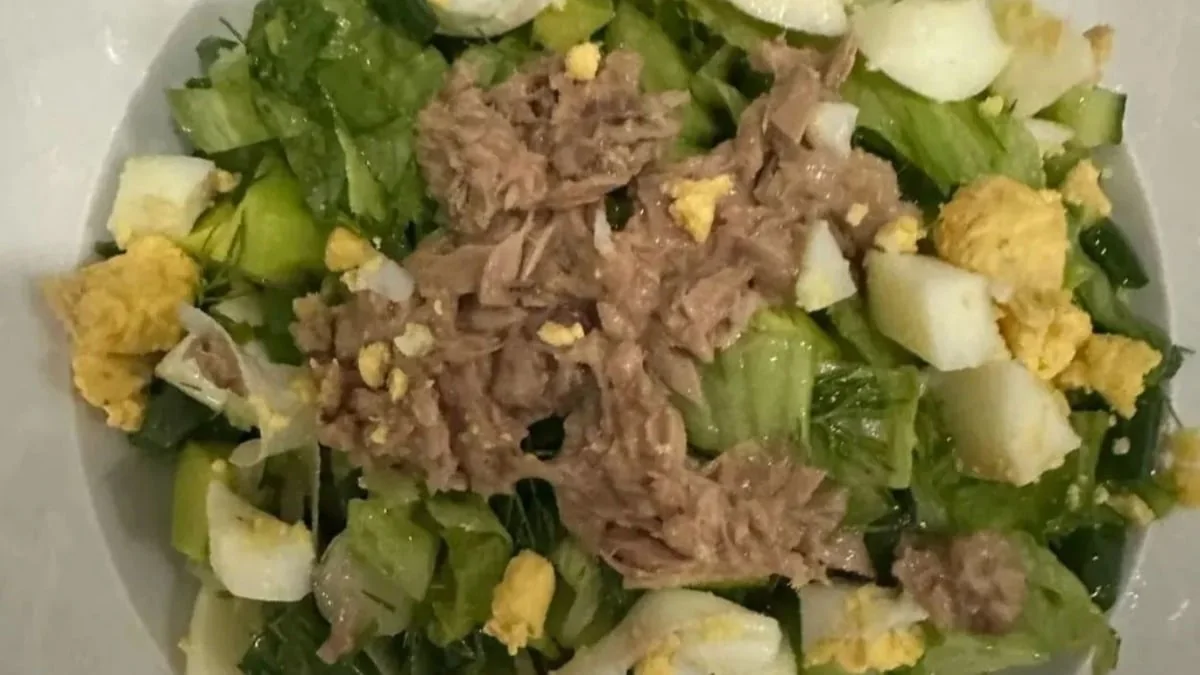
| Avocado tuna salad | 420 | 27 g | 58 % | Avocado, olive oil, tuna |
| Chicken Caesar salad | 480 | 28 g | 52 % | Dressing, Parmesan |
| Hamburger | 640 | 34 g | 48 % | Beef patty, cheddar |
| Avocado toast with poached eggs | 410 | 20 g | 44 % | Avocado, eggs |
| Mac and cheese | 620 | 29 g | 42 % | Cheddar, butter, milk |
| Poke bowl | 540 | 18 g | 30 % | Salmon, avocado |
| Sushi rolls | 420 | 7 g | 15 % | Salmon, tuna |
Two things stand out. First, a high fat percentage does not mean a dish is "too fatty": guacamole and Greek salad are fat-led but fairly low in total calories, and most of their fat is unsaturated. Second, the dishes with the most fat in grams, like the hamburger and mac and cheese, get much of it from cheese, butter and fatty meat, which are the main sources of saturated fat. The point is not to avoid any of them, but to notice where your day's fat is coming from.
Why do fat calories add up so quickly?
Because every gram carries 9 kcal, a little extra fat makes a big difference to the total. Every 10 g of added oil, butter or creamy dressing adds about 90 kcal; a heavy hand that adds 20 g more than you planned adds about 180 kcal, often without making the plate look any bigger.
This is why the same salad can be a light lunch or a substantial meal depending on the dressing, and why pan-frying versus grilling changes a dish's calories. Measuring oil with a spoon for a week or two is a simple way to calibrate your eye; the guide to portion sizes without a scale has practical tricks for when you cannot measure.
Should you cut fat to lose weight?
Weight loss comes from a sustained calorie deficit, whatever mix of protein, carbs and fat creates it. Lowering fat is one easy lever because fat is so calorie-dense, but it is not the only one, and going too low has downsides:
- Below roughly 20 % of calories, it gets harder to absorb fat-soluble vitamins and meet essential fatty acid needs.
- Very low-fat meals can feel less satisfying, which can make a diet harder to stick to.
- "Low-fat" processed products sometimes replace fat with sugar or refined starch, so the calories may not drop as much as the label suggests.
A practical approach is to keep fat inside the 20–35 % range, lean towards unsaturated sources, and watch the portion of added fats such as oils, butter and dressings.
How can you shift towards unsaturated fats?
- Cook with liquid oils such as olive, canola or sunflower oil more often than butter or ghee.
- Include fish, especially oily fish like salmon or sardines, as a regular protein choice.
- Use nuts, seeds and avocado as toppings or snacks, in measured handfuls rather than straight from a large bag.
- Choose leaner cuts and smaller portions of cheese when the rest of the meal already contains fat.
- Read labels for "partially hydrogenated oils", a sign of trans fat in some products.
If you log meals in Sporty, the fat grams for each dish are shown next to protein and carbs, which makes it easy to see whether your day is landing in a sensible range.
When should you get personal advice?
This article is general information. If you have high cholesterol, heart disease, diabetes, a digestive condition that affects fat absorption, or you are pregnant, a doctor or registered dietitian can tailor fat targets to you. The same applies if you have a history of an eating disorder and find tracking numbers stressful.
Frequently asked questions
How many grams of fat should I eat a day to lose weight?
Keep fat within 20–35% of your calorie target. On 1,500 kcal that is about 33–58 g a day; the calorie deficit, not a specific fat number, is what drives weight loss.
Is it bad to eat a high-fat dish?
No single dish decides your diet. A fat-rich meal such as salmon or guacamole can fit easily; what matters is your total intake over the day and that most of your fat comes from unsaturated sources.
How much saturated fat is too much?
The WHO and the Dietary Guidelines for Americans advise keeping saturated fat below 10% of calories. That is under about 22 g a day on 2,000 kcal or under 20 g on 1,800 kcal.
Can I eat too little fat?
Yes. Going below roughly 20% of calories makes it harder to absorb fat-soluble vitamins and get essential fatty acids, and meals may feel less satisfying. If you have a medical reason for a very low-fat diet, follow your doctor's advice.
Sources
This article is general information, not medical advice. If you have a health condition, are pregnant or under 18, talk to a doctor or registered dietitian before changing your diet.