

Whole fruit is not fattening for most people. The WHO does not count the sugar in whole fruit as free sugar, and in three large US cohorts of 133,468 adults, each extra daily serving of fruit was linked to slightly less weight gain over four years. Juice, dried fruit and big fruit bowls are where calories add up faster.
Key takeaways
- The WHO's free-sugar limit (under 10% of energy) covers honey, syrups and fruit juice, not the sugar in whole fruit.
- In a 24-year analysis of 133,468 adults, eating more fruit was associated with slightly less weight gain.
- Fruit juice and smoothies count as at most one of your 5 A Day; the NHS suggests no more than 150 ml a day.
- Fruit bowls can be large meals: Sporty estimates an açaí bowl at 380 kcal with only 7 g of protein.
- Pair fruit with protein, such as yogurt or cottage cheese, for a snack that keeps you full longer.
Does the sugar in fruit count as "sugar"?
Fruit naturally contains sugars, mainly fructose, glucose and sucrose. Chemically they are the same kinds of sugars found in a sugar bowl, which is why fruit sometimes gets a bad name on low-sugar diets. But health agencies treat whole fruit very differently from added sugar.
The World Health Organization recommends limiting free sugars to less than 10% of daily energy, and suggests that going down to 5% or less may bring extra benefits. Free sugars are the sugars added to foods and drinks by manufacturers, cooks or consumers, plus the sugars naturally present in honey, syrups, fruit juices and fruit juice concentrates. The sugar inside whole, fresh fruit is not on that list.
The reason is the package. In a whole apple, orange or handful of berries, the sugar comes with water, fibre and a structure you have to chew. That makes fruit filling for its calories and slows how quickly you can eat a lot of it. Juicing removes most of that, which is why juice is counted as free sugar and whole fruit is not.
What does the research say about fruit and weight?
One of the largest analyses comes from three US cohort studies that followed 133,468 men and women between 1986 and 2010 (Bertoia et al., 2015, PLoS Medicine). Researchers looked at how changes in fruit and vegetable intake over four-year periods related to changes in weight, adjusting for other diet changes, smoking and physical activity.
- Each extra daily serving of fruit was associated with about 0.53 lb (roughly 0.24 kg) less weight gain over four years.
- Berries (−1.11 lb) and apples and pears (−1.24 lb) showed some of the strongest links.
- Starchy vegetables such as potatoes, corn and peas were associated with weight gain, while most non-starchy vegetables were linked to less gain.
This is observational data, so it shows association, not proof that fruit causes weight loss, and the effects are small. But it clearly does not support the idea that whole fruit makes people gain weight. The WHO also recommends that everyone over 10 years old eats at least 400 g of fruit and vegetables a day.
So when can fruit add up?
Fruit is not calorie-free, and some forms make it much easier to eat or drink a lot quickly.
Fruit juice and smoothies
Juice keeps the sugar and loses most of the fibre and chewing. The NHS counts unsweetened 100% fruit juice, vegetable juice and smoothies as a maximum of one portion of your 5 A Day, however much you drink, and suggests keeping them to 150 ml a day in total, about a small glass, ideally with a meal. Liquid calories also tend to be less filling than solid food; our article on liquid calories explains why.
Dried fruit
Drying removes water, so the same sugar and calories come in a much smaller volume. A portion of dried fruit is only about 30 g, roughly one heaped tablespoon of raisins, according to the NHS, which also suggests eating it with meals rather than as a between-meal snack, for the sake of your teeth.
Fruit bowls and fruit desserts
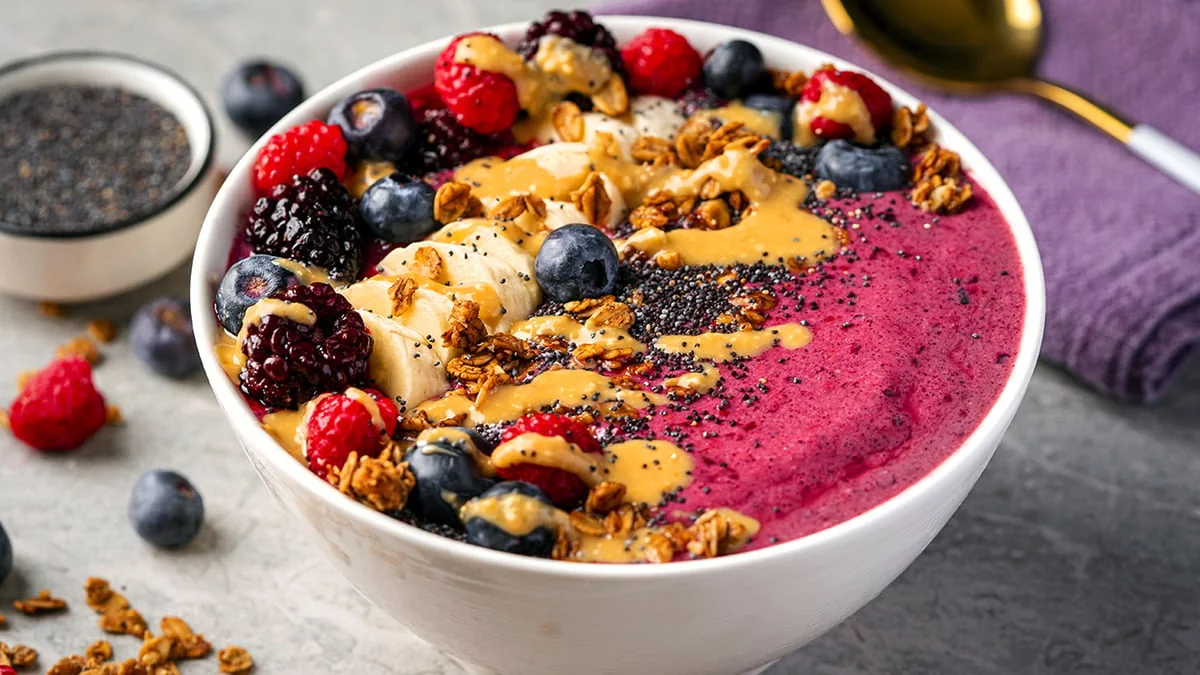
Smoothie bowls and açaí bowls are often seen as light, but with banana, granola, nuts and coconut on top they are full meals. Here are Sporty's per-serving estimates for fruit-based dishes (real values depend on recipe and portion):
| Dish | Calories | Protein | Carbs | Fat |
|---|---|---|---|---|
| Yogurt and fruit | 230 kcal | 16 g | 32 g | 5 g |
| Cottage cheese and walnut fruit bowl | 280 kcal | 26 g | 22 g | 8 g |
| Smoothie bowl | 340 kcal | 9 g | 62 g | 7 g |
| Açaí bowl | 380 kcal | 7 g | 64 g | 12 g |
| Oats, yogurt and fruit | 390 kcal | 22 g | 58 g | 9 g |
The açaí bowl and smoothie bowl are mostly carbohydrate with little protein, so they may leave you hungry sooner. The cottage cheese fruit bowl has fewer calories and almost four times the protein of the açaí bowl. None of these is "bad"; they simply do different jobs.
How much fruit should you eat when losing weight?
There is no special fruit limit for weight loss. The WHO's target of at least 400 g of fruit and vegetables a day works out to five portions of 80 g, the adult portion size the NHS uses. A practical split for many people is two to three portions of fruit and the rest vegetables.
Within a calorie target, fruit is a good trade. It brings fibre, potassium, vitamin C and volume for relatively few calories. Higher fibre intakes are linked to lower body weight and lower risk of several chronic diseases, with the strongest benefits seen at about 25–29 g of fibre a day in a large Lancet review. See how much fibre you need for easy ways to get there.
What are the smartest ways to eat fruit on a diet?
- Eat it whole. An orange instead of orange juice, an apple instead of apple juice. You get the fibre and the fullness.
- Pair it with protein. Fruit with yogurt, kefir, cottage cheese or a handful of nuts keeps you full longer than fruit alone. A bowl of yogurt and fruit is 230 kcal with 16 g of protein.
- Use fruit as dessert. Swapping a pastry or a sweet for fruit after dinner is one of the easiest calorie savings, and it still feels like a treat.
- Measure dried fruit and toppings. A tablespoon of raisins, a few dried apricots or one or two dates is a portion; granola and nut butter on fruit bowls add up quickly.
- Keep juice small. If you love juice, keep to one small glass with a meal.
If you track your food, log fruit too, but don't worry about it. Fruit is rarely the reason someone is stuck. Our guide to sugar limits and hidden sources shows where added sugar usually comes from instead: drinks, sweets, sauces and baked goods. Sporty logs fruit by photo or barcode in seconds and shows it alongside the rest of your day.
Who should be more careful with fruit?
People with diabetes can and usually should eat fruit, but they may need to spread it through the day and count its carbohydrate as part of their plan. People with kidney disease are sometimes advised to limit high-potassium fruits. If either applies to you, or you are pregnant, have a history of disordered eating or are under 18, follow the advice of your doctor or registered dietitian.
For everyone else, the bottom line is simple: whole fruit is not fattening. It is one of the most filling, nutrient-rich foods you can eat for the calories. Juice, dried fruit and large topped bowls deserve a little more attention, not because they are fruit, but because they make it easy to take in more energy than you notice.
Frequently asked questions
Does fruit sugar make you gain weight?
Not in whole fruit for most people. Large cohort studies link eating more fruit with slightly less weight gain, and the WHO does not count the sugar in whole fruit as free sugar.
Is fruit juice as healthy as whole fruit?
No. Juice counts as free sugar and loses most of the fibre. The NHS counts juice as at most one of your 5 A Day and suggests no more than 150 ml a day.
Can I eat fruit at night when trying to lose weight?
Yes. What matters is your total calories over the day, not the clock. Fruit is a lighter dessert than most sweets.
How many portions of fruit should I eat a day?
The WHO recommends at least 400 g of fruit and vegetables a day, about five 80 g portions. Two to three portions of fruit with the rest vegetables works well for many people.
Was this article helpful?
No ratings yet — be the first.
Tap a star to rate it — your rating helps us improve and helps other readers.
Sources
- WHO, Healthy diet fact sheet
- NHS, 5 A Day portion sizes
- Bertoia et al. 2015, Changes in intake of fruits and vegetables and weight change in US men and women followed for up to 24 years (3 cohorts, 133,468 adults, PLoS Med)
- Reynolds et al. 2019, Carbohydrate quality and human health: systematic reviews and meta-analyses (The Lancet)
This article is general information, not medical advice. If you have a health condition, are pregnant or under 18, talk to a doctor or registered dietitian before changing your diet.