
Most adults should aim for at least 25 g of fibre a day (WHO, EFSA), and the UK advises 30 g, yet typical intakes sit nearer 20 g. A 2019 Lancet analysis of 185 cohort studies and 58 trials linked eating the most fibre with 15–30% lower risk of early death, heart disease, type 2 diabetes and colorectal cancer.
Key takeaways
- WHO, EFSA and TÜBER set at least 25 g of fibre a day for adults; the UK recommends 30 g.
- A 2019 Lancet analysis found the biggest risk reductions at 25–29 g a day.
- A cup of cooked lentils has about 15.6 g of fibre, white rice about 0.6 g.
- Pulses, whole grains such as bulgur and oats, fruit with skin and nuts are the easiest sources.
- Increase fibre gradually over two to three weeks and drink enough fluid.
How much fibre do you need per day?
For most adults the answer is at least 25 g a day. The World Health Organization advises people aged 10 and over to get at least 25 g of naturally occurring fibre daily from whole grains, vegetables, fruit and pulses. The European Food Safety Authority (EFSA) considers 25 g a day adequate for normal bowel function in adults, and Türkiye's national nutrition guide (TÜBER) uses the same 25 g floor. The UK goes higher and sets 30 g.
| Source | Adult recommendation |
|---|---|
| WHO | At least 25 g/day of naturally occurring fibre |
| EFSA (EU) | 25 g/day adequate for normal bowel function |
| TÜBER (Türkiye) | At least 25 g/day |
| UK government (NHS) | 30 g/day |
The gap between advice and reality is large. According to the NHS, most UK adults eat only about 20 g a day, and 11 to 18-year-olds average about 16 g. Children need less than adults: roughly 15 g at ages 2 to 5, 20 g at 5 to 11 and 25 g at 11 to 16.
What did the big Lancet review find?
The strongest modern evidence comes from a series of systematic reviews and meta-analyses commissioned to inform WHO guidance and published in The Lancet in 2019. Reynolds and colleagues pooled just under 135 million person-years of data from 185 prospective studies, plus 58 clinical trials with 4,635 adults.
- People who ate the most fibre had a 15–30% lower risk of death from any cause and from cardiovascular disease, and lower rates of coronary heart disease, stroke, type 2 diabetes and colorectal cancer, compared with those who ate the least.
- The risk reductions were greatest at 25–29 g a day, and the dose-response curves suggested that even higher intakes might bring further benefit.
- In the clinical trials, higher fibre intakes led to lower body weight, systolic blood pressure and total cholesterol.
Most of these data are observational, so they show associations rather than proof that fibre alone causes the benefit. Still, the authors graded the certainty of evidence for fibre as moderate and noted that the consistent dose-response pattern suggests the links could be causal. The findings apply to the general population, not to people already living with a chronic disease.
Why does fibre help when you are managing your weight?
Fibre-rich foods tend to be bulky, need more chewing and are often lower in energy per bite. Pulses are the clearest example because they bring protein too. Here is what USDA data show for one cooked cup:
| 1 cup cooked | Energy | Fibre | Protein |
|---|---|---|---|
| Lentils (198 g) | 230 kcal | 15.6 g | 17.9 g |
| Bulgur (182 g) | 151 kcal | 8.2 g | 5.6 g |
| Spaghetti (124 g) | 196 kcal | 2.2 g | 7.2 g |
| White rice (158 g) | 205 kcal | 0.6 g | 4.3 g |
A cup of lentils carries about 26 times the fibre of a cup of white rice for a similar number of calories. You do not have to give up rice or pasta, but mixing in pulses or swapping some of the grain for bulgur changes the picture quickly. Fibre does not cancel out calories, though; a calorie deficit still decides weight loss. For the bigger picture of how carbohydrates fit into your day, see macros explained.
Which foods have the most fibre?
These per-portion values are calculated from USDA FoodData Central. Real numbers vary by variety and preparation.
| Food and portion | Fibre | Energy |
|---|---|---|
| Cooked white beans, 1 cup (179 g) | 11.3 g | 249 kcal |
| Cooked chickpeas, 1 cup (164 g) | 12.5 g | 269 kcal |
| Raspberries, 1 cup (123 g) | 8.0 g | 64 kcal |
| Pear, 1 medium (178 g) | 5.5 g | 101 kcal |
| Apple with skin, 1 medium (182 g) | 4.4 g | 95 kcal |
| Oats, dry, 40 g | 4.0 g | 152 kcal |
| Almonds, 28 g (about 23 nuts) | 3.5 g | 164 kcal |
| Broccoli, cooked, ½ cup (78 g) | 2.6 g | 27 kcal |
| Whole-wheat bread, 1 slice (32 g) | 1.9 g | 81 kcal |
| White bread, 1 slice (29 g) | 0.8 g | 77 kcal |
Two easy patterns stand out: pulses lead the list, and keeping the skin matters. A medium apple without its skin drops to about 2 g of fibre.
What does a 30 g fibre day look like?
You do not need special products. Here is one ordinary day built from the table above:
| Meal | Foods | Fibre |
|---|---|---|
| Breakfast | 40 g oats cooked with milk, 1 apple with skin | 8.4 g |
| Lunch | ½ cup cooked lentils in a soup or salad, 1 slice whole-wheat bread | 9.7 g |
| Snack | 28 g almonds | 3.5 g |
| Dinner | 1 cup bulgur pilaf with chicken, ½ cup broccoli | 10.8 g |
| Total | 32.4 g |
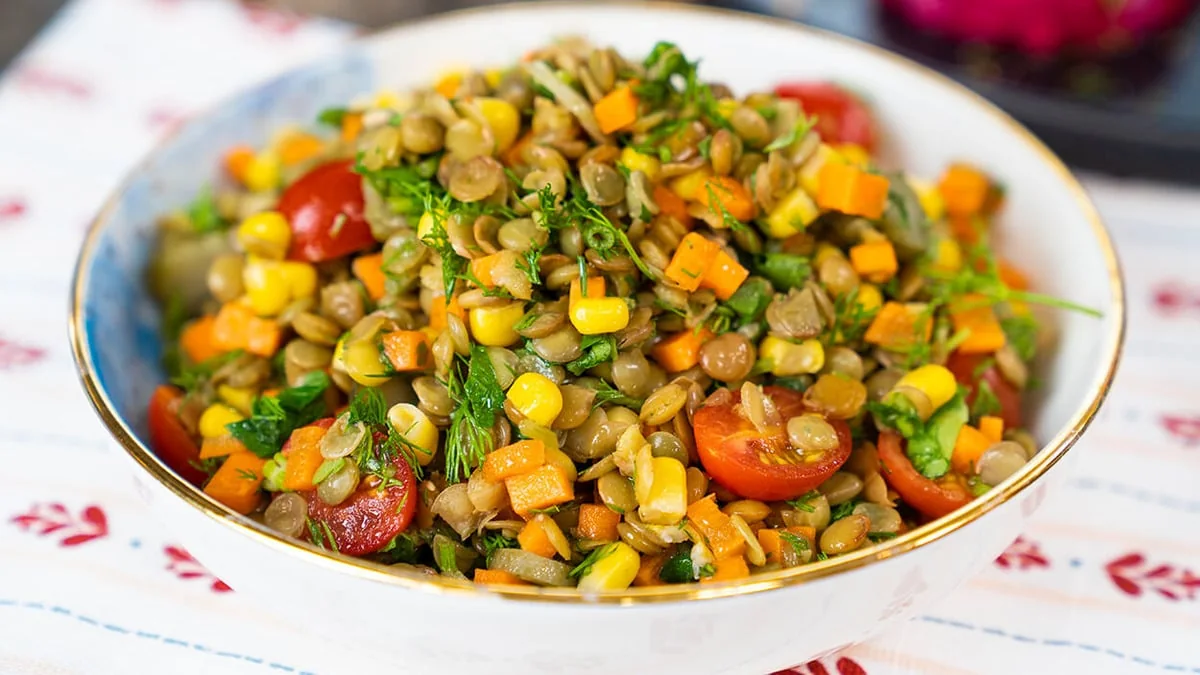
Many favourite dishes around the world are already fibre-friendly: Turkish red lentil soup and kısır, Mexican chilli with beans, Italian minestrone, Middle Eastern hummus and falafel, Indian dal. A plain bulgur pilaf in place of white rice is one of the simplest swaps. In Sporty's per-serving estimates, a lentil salad is about 320 kcal with 16 g protein and hummus with vegetables about 260 kcal; real values depend on recipe and portion.
Which simple swaps add the most fibre?
- White rice to bulgur (1 cup): about +7.6 g.
- Half the meat in a stew to beans or lentils: roughly +5–8 g per serving.
- Juice to whole fruit: a pear instead of a glass of juice adds about 5 g and fewer free sugars; see sugar limits and hidden sources.
- White bread to whole-wheat (2 slices): about +2 g.
- Add a handful of berries or nuts to yogurt or oats: +3–8 g.
How do you increase fibre without bloating?
A sudden jump from 15 g to 35 g can cause gas and bloating. Most people do better adding one fibre-rich food every few days over two to three weeks, spreading fibre across meals and drinking enough fluid through the day. Pulses that are well cooked, rinsed canned beans and smaller portions at first are usually easier to tolerate.
If you have irritable bowel syndrome, inflammatory bowel disease, a history of bowel surgery, kidney disease or another medical condition, ask a doctor or registered dietitian which types and amounts suit you. The same applies to children and to anyone with ongoing digestive symptoms.
Do fibre supplements count?
WHO's 25 g target refers to naturally occurring fibre in foods. Whole foods bring vitamins, minerals and other plant compounds along with the fibre, which supplements do not. A supplement can still be useful for some people on medical advice, but for most of us the food route is the one the evidence is built on. Logging meals in Sporty can show whether your usual day lands nearer 15 g or 30 g.
Frequently asked questions
How much fibre should I eat a day?
At least 25 g a day for adults according to WHO and EFSA; the UK recommends 30 g. Children need less, roughly 15–25 g depending on age.
Which food has the most fibre?
Pulses lead: a cup of cooked lentils has about 15.6 g and a cup of chickpeas about 12.5 g, per USDA data. Raspberries, pears, oats, bulgur and almonds are also good sources.
Does fibre help with weight loss?
In clinical trials, higher fibre intakes were linked with lower body weight, and fibre-rich foods tend to be filling for their calories. Weight loss still depends on an overall calorie deficit.
Can too much fibre be a problem?
Increasing it suddenly can cause gas and bloating, so add it over a few weeks with enough fluid. People with bowel or kidney conditions should ask a doctor or dietitian.
Is fruit juice a good source of fibre?
No. Juicing removes most of the fibre and turns the sugar into free sugars. Whole fruit, ideally with the skin, is the better choice.
Sources
This article is general information, not medical advice. If you have a health condition, are pregnant or under 18, talk to a doctor or registered dietitian before changing your diet.