

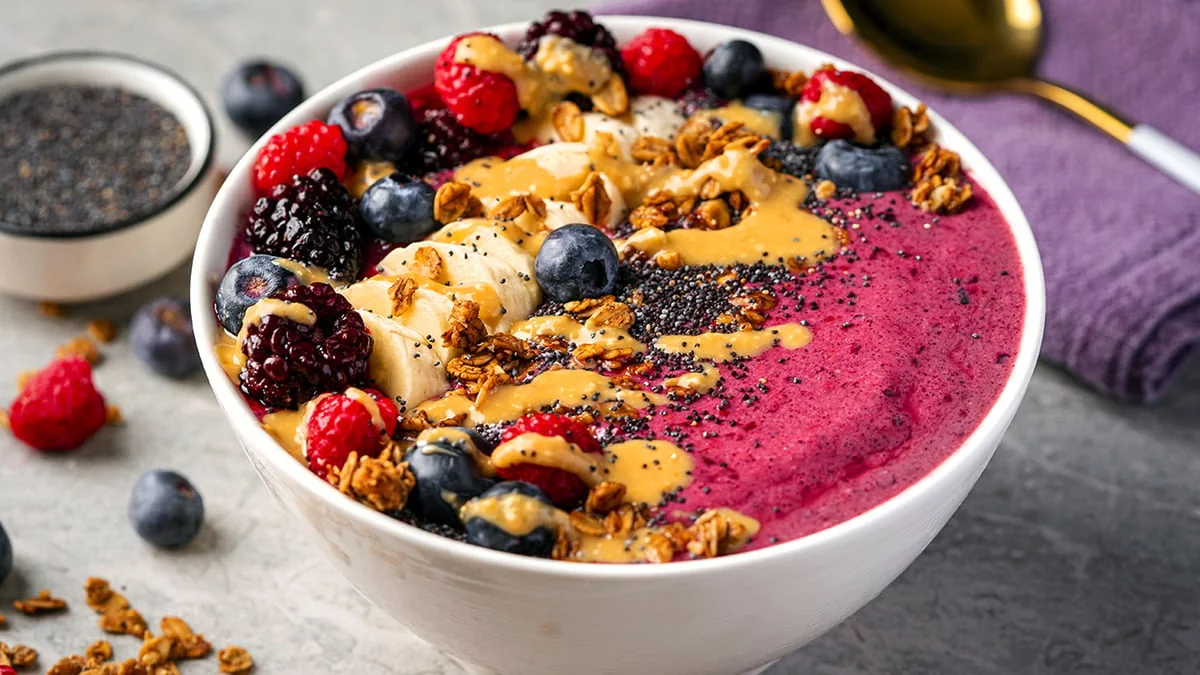
Whole fruit keeps its fibre and structure, while juicing releases its sugars. The WHO and NHS count sugars in fruit juice, even unsweetened, as free sugars, but not sugars in whole fruit. The NHS says 150 ml of juice counts as one of your 5 a day at most, so eat fruit whole and keep juice to one small glass.
Key takeaways
- Sugars in fruit juice count as free sugars; sugars in whole fruit do not.
- The NHS caps juice and smoothies at 150 ml a day, counting as one of your 5 a day at most.
- The WHO advises keeping free sugars below 10% of energy, about 50 g on 2,000 kcal.
- In a large US cohort analysis, more juice was linked to slightly higher type 2 diabetes risk, more whole fruit to slightly lower risk.
- Whole fruit adds volume and fibre and does not need to be cut back.
What actually changes when fruit becomes juice?
An orange, an apple or a handful of grapes and the juice pressed from them start out with the same natural sugars. What changes is the structure. When fruit is juiced, the cell walls are broken and most of the fibre-rich pulp and skin is left behind. The sugars that were locked inside the fruit's cells are now dissolved in liquid, ready to drink in a few seconds.
That is why health bodies treat the two differently. The World Health Organization counts the sugars naturally present in fruit juices and juice concentrates as free sugars, the same category as table sugar, honey and syrups. The sugars inside whole fruit are not free sugars. The NHS makes the same distinction: sugar in fruit only counts as free sugar once the fruit has been juiced or puréed.
Why does that distinction matter?
Free sugars are the type of sugar that guidelines ask us to limit. The WHO recommends keeping free sugars below 10% of daily energy, which is about 50 g on a 2,000 kcal day, and suggests that going below 5% may bring further benefits. The NHS sets a practical ceiling of 30 g of free sugars a day for adults.
Unsweetened juice still counts. "No added sugar" on the carton means nothing was added during production; it does not mean the juice is free of free sugars. Since carbohydrates provide 4 kcal per gram, 30 g of sugar is about 120 kcal, and it is easy to get there from drinks alone without feeling that you have eaten anything. Our guide to daily sugar limits and hidden sources shows where else free sugars tend to hide.
Does juice count towards your 5 a day?
Yes, but only once. Under the NHS 5 A Day guidance, 150 ml of fruit juice, vegetable juice or smoothie counts as one portion, and that is the maximum: drinking more does not add extra portions. The NHS also advises keeping the combined total of juice and smoothies to 150 ml a day and drinking it with a meal, because the released sugars can damage teeth.
| Whole fruit | Fruit juice | |
|---|---|---|
| Are the sugars free sugars? | No | Yes (WHO, NHS) |
| Fibre and pulp | Kept | Mostly removed |
| Counts towards 5 a day | Each 80 g portion counts | Maximum one portion (150 ml) |
| How fast you consume it | Slow, needs chewing | Seconds |
| Effect on fullness | Chewing and volume help you feel full | Liquid calories tend to fill you up less |
Is fruit juice linked to health outcomes?
The best-known evidence comes from a large observational analysis published in the BMJ in 2013 by Muraki and colleagues. It followed about 187,000 nurses and other health professionals in three US cohorts for many years. People who ate more whole fruit had a slightly lower risk of type 2 diabetes, while people who drank more fruit juice had a slightly higher risk: about 8% higher for every three extra servings a week. Swapping three servings of juice a week for the same amount of whole fruit was linked to a 7% lower risk.
This kind of study shows associations, not proof of cause, and people who drink a lot of juice may differ in other ways. Still, the direction is consistent with the guidelines: whole fruit is the better default, and juice is best treated as an occasional extra rather than as a fruit serving you can drink in large amounts.
Is whole fruit "too sugary" for weight loss?
No. This is a common mix-up. The sugars in whole fruit come packaged with water, fibre and bulk, and the NHS says there is no need to cut them down. The WHO recommends at least 400 g of fruit and vegetables a day. If you are worried that fruit slows weight loss, our article on whether fruit is fattening goes through the evidence. In a calorie deficit, whole fruit is one of the easier ways to add volume and sweetness for relatively few calories.
What about smoothies?
Smoothies sit between the two. Blending keeps more of the fibre than juicing, but the NHS still groups smoothies with juice: they count as one portion at most, and their sugars are free sugars because the fruit has been puréed. A smoothie can still be a useful breakfast if it is built like a meal, with yogurt or milk for protein, rather than as a large glass of blended fruit. Our guide to building a filling smoothie covers that approach.
Here is how some fruit-based breakfasts compare, using Sporty's per-serving estimates (real values depend on recipe and portion):
| Dish | kcal | Protein | Carbs |
|---|---|---|---|
| Yogurt and fruit | 230 | 16 g | 32 g |
| Cottage cheese and walnut fruit bowl | 280 | 26 g | 22 g |
| Oats, yogurt and fruit | 390 | 22 g | 58 g |
| Smoothie bowl | 340 | 9 g | 62 g |
| Açaí bowl | 380 | 7 g | 64 g |
The blended bowls are not "bad", but notice the pattern: when fruit is the whole meal, protein is low and carbs are high. Pairing whole fruit with yogurt or cottage cheese gives more protein for fewer calories, which usually keeps you fuller until lunch.
How can you enjoy juice without overdoing it?
- Keep it to one small glass. 150 ml with a meal is the NHS limit and a reasonable habit.
- Use a smaller glass. Many glasses hold 250–300 ml, which is nearly double the limit when full.
- Dilute it. Half juice, half sparkling or still water keeps the flavour with half the sugar.
- Eat the fruit instead. When you are thirsty, choose water; when you want fruit, eat it whole.
- Count it. Juice is easy to forget in a food diary. Logging drinks makes liquid calories visible; see our article on liquid calories that add up.
If you log your breakfast in Sporty, include the glass of juice as its own item so it shows up in your daily total rather than disappearing.
Who should take more care?
People with diabetes should be cautious with juice because it delivers sugar quickly; a doctor or registered dietitian can advise on how it fits their plan. Juice is also a common source of free sugars for children, and parents of young children may want to ask a health professional for age-specific advice. For everyone else, the takeaway is simple: whole fruit freely, juice in small amounts.
Frequently asked questions
Is 100% fruit juice as healthy as fruit?
Not quite. Juice keeps vitamins but loses most of the fibre, and its sugars count as free sugars. The NHS counts 150 ml of juice as only one of your 5 a day, however much you drink.
How much fruit juice is OK per day?
The NHS suggests no more than 150 ml of juice and smoothies combined a day, ideally with a meal to protect your teeth.
Does sugar in whole fruit count towards the sugar limit?
No. The WHO and NHS limits apply to free sugars, which include juice but not the sugars inside whole fruit.
Are smoothies better than juice?
Smoothies keep more fibre, but the NHS treats them like juice: one portion at most and free sugars. Adding yogurt or milk makes them more filling.
Was this article helpful?
No ratings yet — be the first.
Tap a star to rate it — your rating helps us improve and helps other readers.
Sources
This article is general information, not medical advice. If you have a health condition, are pregnant or under 18, talk to a doctor or registered dietitian before changing your diet.