

On rest days, keep eating normal meals with the same daily protein target, around 1.4–2.0 g per kg for people who train. Your activity factor already averages training and rest days, so large calorie cuts are not needed. If you want, eat slightly less starchy food and more vegetables, and keep your weekly total steady.
Key takeaways
- Your activity factor describes your typical week, so rest days are already built into your calorie target.
- Keep protein the same on rest days: the ISSN suggests 1.4–2.0 g/kg a day for people who exercise.
- If you adjust anything, trim a portion of starchy food rather than cutting carbohydrates out.
- A sample rest day of four catalog meals gives about 1,640 kcal and 111 g of protein.
- Light movement such as a 30-minute easy walk is fine on rest days and adds roughly 130 kcal at 70 kg.
Do you need to eat differently on rest days?
Rest days are part of training, not a break from it. Muscles adapt and recover in the hours and days between sessions, and that work runs on the food you eat. Many people still wonder whether they should cut calories sharply on days off, skip carbohydrates, or eat exactly as they do on training days. The short answer is that most people need only small adjustments: keep protein steady, keep eating vegetables, fruit and whole grains, and trim a little from portions of starchy food if your training day included extra snacks or a recovery meal.
How many calories do you need on a rest day?
Your daily calorie need is usually estimated from your resting energy expenditure (for example with the Mifflin-St Jeor equation) multiplied by an activity factor of 1.2, 1.375, 1.55, 1.725 or 1.9. That factor describes your typical week, not a single day. If you train four days a week and chose a factor of 1.55, your target already averages your hard and easy days.
Here is a worked example for a 30-year-old woman who weighs 65 kg (143 lb) and is 165 cm tall:
| Step | Calculation | Result |
|---|---|---|
| Resting energy (Mifflin-St Jeor) | 10 × 65 + 6.25 × 165 − 5 × 30 − 161 | about 1,370 kcal |
| Moderately active week | 1,370 × 1.55 | about 2,124 kcal |
| Sedentary factor, for comparison | 1,370 × 1.2 | about 1,644 kcal |
Switching between 2,124 kcal on training days and 1,644 kcal on rest days would double-count the rest, because the 1.55 factor already includes them. A simpler approach works for most people: eat roughly the same amount every day, or move a few hundred calories of carbohydrate from rest days to training days while keeping the weekly total the same. Our guide to TDEE and your maintenance number explains the activity factors in more detail.
Should you keep eating protein on rest days?
Yes. Protein targets are daily targets, and the repair and building of muscle continues on the days between workouts. The International Society of Sports Nutrition (ISSN) suggests 1.4–2.0 g of protein per kg of body weight a day for people who exercise, spread across meals of roughly 20–40 g every few hours. The adult minimum (RDA) is 0.8 g/kg.
| Body weight | RDA (0.8 g/kg) | ISSN range (1.4–2.0 g/kg) | Per meal, 4 meals |
|---|---|---|---|
| 60 kg (132 lb) | 48 g | 84–120 g | 21–30 g |
| 70 kg (154 lb) | 56 g | 98–140 g | 25–35 g |
| 85 kg (187 lb) | 68 g | 119–170 g | 30–43 g |
The ISSN also notes that total daily protein matters more than precise timing, so there is no need to plan rest-day meals around the clock. For more on this, see does protein timing matter?
Do you need fewer carbs on a rest day?
Carbohydrates are the main fuel for hard training, so it makes sense that some people eat a bit more on training days and a bit less on rest days. That does not mean cutting them out. The US National Academies set an acceptable range of 45–65 % of energy from carbohydrate for adults, and whole grains, fruit, vegetables and pulses also provide fibre and vitamins. On a rest day, a practical change is a smaller portion of rice, pasta or bread at one meal, with more vegetables or salad on the plate instead. For example, you could keep the fish or chicken and the vegetables exactly the same and simply serve a smaller portion of potatoes or rice. The meal stays filling because protein and vegetables make up most of the plate, and you can go back to your usual portion on the next training day.
What does a rest day of eating look like?
Here is one example built from dishes in our meal catalog, compared with a training day that adds a recovery snack. The numbers are our per-serving estimates; real values depend on recipe and portion. It is an illustration, not a meal plan.
| Meal | Rest day | kcal | Protein |
|---|---|---|---|
| Breakfast | Oats, yogurt and fruit | 390 | 22 g |
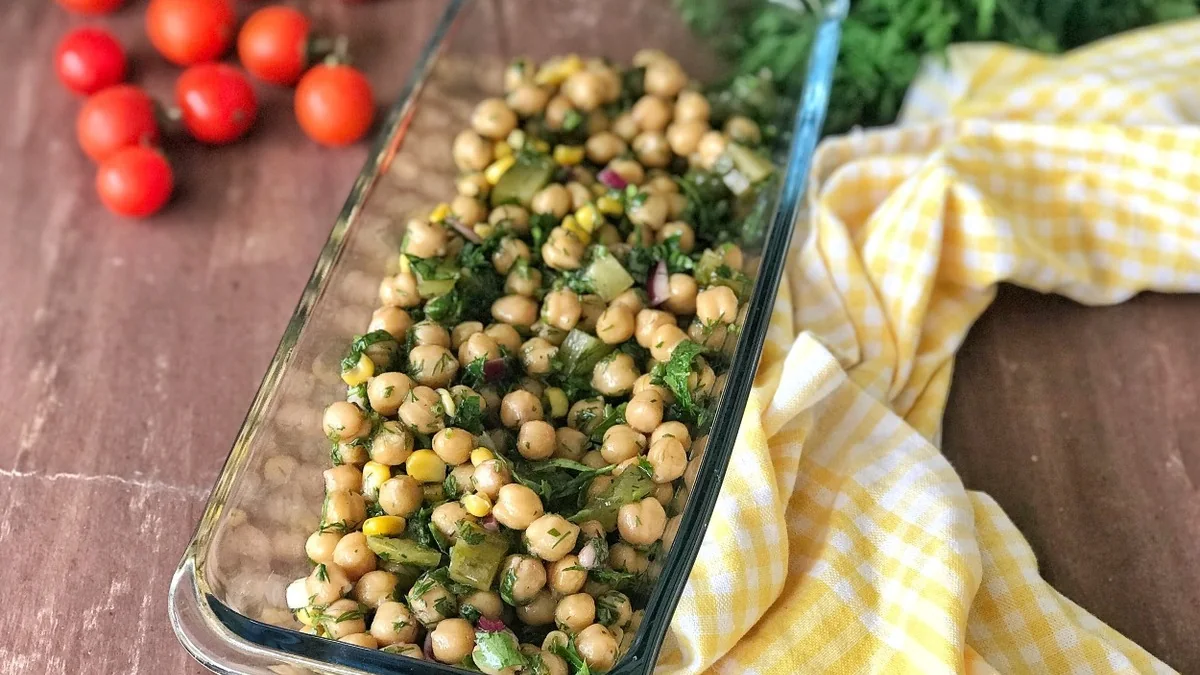
| Lunch | Mediterranean chickpea salad | 430 | 19 g |
| Snack | Cottage cheese and walnut fruit bowl | 280 | 26 g |
| Dinner | Baked salmon and sweet potato | 540 | 44 g |
| Total | 1,640 | 111 g |
For a 70 kg adult, 111 g of protein is about 1.6 g/kg, inside the ISSN range. On a training day, the same person might add a bowl of yogurt and fruit after the session (230 kcal, 16 g of protein), for a total of about 1,870 kcal and 127 g. The difference between the two days is modest, which is the point: rest days do not need a separate diet.
The Mediterranean chickpea salad brings fibre and plant protein to lunch, and the baked salmon and sweet potato adds omega-3 fats and a moderate amount of carbohydrate at dinner.
How do you avoid overeating on rest days?
Some people find they are hungrier the day after a hard session, and with more free time, snacking can creep up. A few habits help:
- Keep your normal meal pattern. Regular meals with protein at each one tend to keep hunger more even.
- Fill half the plate with vegetables. The WHO recommends at least 400 g of fruit and vegetables a day, and they add volume for few calories.
- Plan one satisfying snack rather than grazing, for example yogurt and fruit or hummus with raw vegetables.
- Watch drinks. Juices, sweet coffees and alcohol add calories without much fullness.
- Look at the week, not the day. One bigger day does not undo a week; our guide to keeping your weekly average shows how it balances out.
Should rest days be completely inactive?
Rest from training does not have to mean sitting all day. Light movement, such as an easy walk, can help you feel less stiff and adds a little to your energy use. As a rough guide, comfortable walking (about 3.5 MET in the Compendium of Physical Activities) uses around 4.3 kcal a minute for a 70 kg adult, so a 30-minute walk adds roughly 130 kcal. This varies with body size and pace, and it is not something you need to "earn" food with.
If you track your food, logging rest days works the same way as any other day. In Sporty you can snap a photo of your plate or describe it in a sentence and see the calories left for the day, which makes it easy to check that a quieter day still includes enough protein.
Who should get personal advice?
These are general guidelines for healthy adults. If you are pregnant, under 18, have kidney disease, diabetes or another medical condition, or have a history of disordered eating, talk to a doctor or registered dietitian before changing how you eat around training. Do not go below 1,200 kcal a day for women or 1,500 kcal for men without medical supervision.
Frequently asked questions
Should I eat less on rest days?
Only slightly, if at all. Your calorie target is usually based on your whole week, so many people eat about the same each day or move a few hundred calories from rest days to training days.
Do I need protein on rest days?
Yes. Protein needs are daily, and muscle repair continues between workouts. Aim for your usual daily target spread over your meals.
Should I cut carbs on rest days?
There is no need to cut them out. A smaller portion of rice, pasta or bread at one meal, with more vegetables, is a simple adjustment if you want one.
Is it normal to be hungrier on a rest day?
Some people are hungrier the day after a hard session. Regular meals with protein, plenty of vegetables and a planned snack usually help.
Was this article helpful?
No ratings yet — be the first.
Tap a star to rate it — your rating helps us improve and helps other readers.
Sources
This article is general information, not medical advice. If you have a health condition, are pregnant or under 18, talk to a doctor or registered dietitian before changing your diet.