

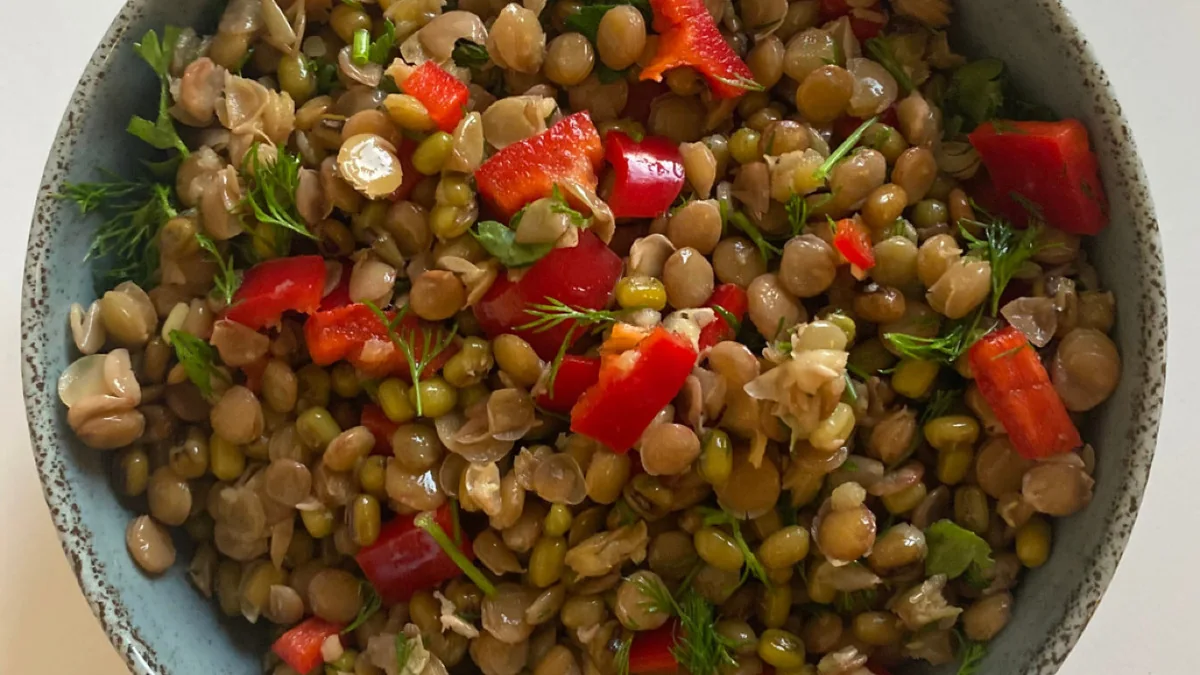
A salad fills you up when it has a real protein source (about 25–30 g), a fibre-rich carb like beans, lentils or bulgur, plenty of vegetables and a measured amount of oil. In our catalog, tuna, chicken and Niçoise salads give 30–52 g of protein for 380–520 kcal; a shepherd's salad alone gives 3 g.
Key takeaways
- Main-meal salads that fill you up have a clear protein source; most land between 380 and 520 kcal.
- In a 2004 study, low-calorie-density salads cut lunch intake by 7–12%, while high-calorie-density ones raised it by 8–17%.
- One tablespoon of olive oil is about 120 kcal, so measure dressing instead of pouring freely.
- Light salads like shepherd's salad are great sides: paired with chicken shish they make a 540 kcal meal with 49 g of protein.
Why do some salads leave you hungry an hour later?
A bowl of lettuce, tomato and cucumber is large, fresh and low in calories, which is exactly why it often does not last. A classic shepherd's salad in our catalog is about 160 kcal with 3 g of protein. That is a great side dish, but as a whole meal it gives your body very little to work with, and many people end up snacking soon after.
The opposite problem is just as common: a salad that looks light but is built on dressing, cheese, croutons and nuts, and quietly reaches the calories of a burger. A filling salad sits between those two extremes. It has enough protein and fibre to keep you satisfied, plenty of vegetables for volume, and a measured amount of fat for flavour.
What does the research say about salads and fullness?
A well-known study from Penn State, published in 2004, tested this directly. Forty-two women ate lunch in a lab once a week for seven weeks. On some days they first had to eat a salad, then could eat as much pasta as they liked. The salads differed only in portion (150 g or 300 g) and in energy density, which the researchers changed by adjusting the amount and type of dressing and cheese.
- Low-calorie-density salads reduced total lunch intake compared with no salad: by 7% for the small portion and 12% for the large one.
- High-calorie-density salads increased total lunch intake: by 8% for the small portion and 17% for the large one.
The takeaway is not "salad is good" or "dressing is bad". It is that the same bowl can either help or work against you depending on what goes into it. Volume from vegetables helps; heavy dressing and cheese in large amounts can tip the balance. Our guide on feeling fuller on fewer calories covers the same principle beyond salads.
What makes a salad filling?
Think of a main-meal salad as four parts:
- Protein, about 25–30 g: chicken, tuna, eggs, white cheese, beans, lentils or chickpeas. A 2015 review in the American Journal of Clinical Nutrition linked roughly 25–30 g of protein per meal with better appetite control, while noting the effect on fullness is modest.
- A fibre-rich carbohydrate: bulgur, beans, lentils, chickpeas, potatoes or a slice of wholegrain bread. Legumes do double duty as protein and fibre; see how much fibre you need.
- Lots of vegetables: greens, tomato, cucumber, peppers, onion, parsley. These add size and crunch for very few calories, and count towards the WHO advice of at least 400 g of fruit and vegetables a day.
- A measured amount of fat: olive oil, olives, avocado, feta or walnuts. According to USDA data, one tablespoon of olive oil is about 120 kcal, so a free pour of three tablespoons adds roughly 360 kcal before anything else is on the plate.
Which salads fill you up best?
Here is how salads in our meal catalog compare. The numbers are Sporty's per-serving estimates; real values depend on recipe and portion. "Protein per 100 kcal" shows how much protein you get for the calories.
| Salad | kcal | Protein | Protein per 100 kcal | As a meal |
|---|---|---|---|---|
| Tuna salad and yogurt | 480 | 52 g | 10.8 g | Very filling |
| Chicken quinoa power bowl | 520 | 50 g | 9.6 g | Very filling |
| Chicken salad with avocado | 380 | 36 g | 9.5 g | Very filling |
| Chicken Caesar salad | 480 | 38 g | 7.9 g | Filling |
| Avocado tuna salad | 420 | 32 g | 7.6 g | Filling |
| Protein power salad (chicken, eggs, chickpeas, feta) | 460 | 34 g | 7.4 g | Filling |
| Niçoise salad | 430 | 30 g | 7.0 g | Filling |
| Protein-packed vegan salad | 420 | 20 g | 4.8 g | Good, add a protein side |
| Mediterranean chickpea salad | 430 | 19 g | 4.4 g | Good, add a protein side |
| Piyaz (white bean salad with egg) | 330 | 14 g | 4.2 g | Good with soup or grilled fish |
| Greek salad | 290 | 9 g | 3.1 g | Side dish |
| Kısır | 340 | 8 g | 2.4 g | Side dish |
| Shepherd's salad | 160 | 3 g | 1.9 g | Side dish |
The pattern is clear: the salads that work as a full meal all have a substantial protein source, and most of them land between 380 and 520 kcal. The lighter salads at the bottom are not "worse"; they are side dishes, and they shine next to a protein.
How do you turn a side salad into a meal?
You do not have to give up the salads you like. Pair them instead:
| Combination | kcal | Protein |
|---|---|---|
| Shepherd's salad + chicken shish | 540 | 49 g |
| Shepherd's salad + red lentil soup | 410 | 16 g |
| Shepherd's salad + piyaz | 490 | 17 g |
| Greek salad + grilled fish and vegetables | 740 | 57 g |
| Kısır + cacık | 460 | 15 g |
Shepherd's salad with chicken shish is the standout: under 550 kcal with nearly 50 g of protein. The lentil soup and piyaz pairings are lighter on protein but rich in fibre from legumes, which also helps with fullness.
Worked example: same bowl, two very different salads
Imagine a big bowl of greens, tomato and cucumber, very few calories on its own. Now look at two ways to finish it:
- Version A: 150 g grilled chicken breast, half an avocado, one tablespoon of olive oil with lemon. This is close to the chicken salad in our catalog: about 380 kcal and 36 g of protein.
- Version B: the same greens with a large handful of croutons, plenty of grated cheese and three free-poured tablespoons of oil-based dressing. The oil alone adds about 360 kcal before the croutons and cheese are counted, and without a real protein source it delivers a fraction of the protein.
Version A will probably keep you full for longer, for fewer calories. The difference is not the lettuce; it is the protein and the dressing.
Five practical tips for filling salads
- Start with protein, then build around it. If a salad has no obvious protein, add eggs, tuna, beans or white cheese.
- Measure the oil once. Pour one tablespoon into the spoon, not straight from the bottle, and see how far it goes. Lemon, vinegar, pomegranate molasses and yogurt stretch it further.
- Add a legume or grain for staying power: chickpeas, lentils, white beans, bulgur or quinoa.
- Make it big. The Penn State study found the larger, low-calorie-density salad cut lunch intake the most.
- Watch the toppings that add up quietly: croutons, fried halloumi, candied nuts and creamy dressings. They are fine in measured amounts; they are just not free.
When you log a salad in Sporty by photo or by describing it, mention the dressing and any cheese or nuts, because that is where most of the calorie difference sits. If you are pregnant, have a medical condition or follow a medically prescribed diet, a registered dietitian can help adjust these ideas to your needs.
Frequently asked questions
Can a salad be a full meal?
Yes, if it includes a protein source such as chicken, tuna, eggs or legumes and some fibre-rich carbohydrate. Without those, a vegetable-only salad is better treated as a side dish.
Which salad has the most protein?
In our catalog, tuna salad with yogurt has the most, at about 52 g of protein for 480 kcal, followed by the chicken quinoa bowl at 50 g for 520 kcal (Sporty estimates).
How much dressing should I use on a salad?
One tablespoon of olive oil, about 120 kcal, with lemon or vinegar is enough for a large bowl for most people. Measuring it once helps you see how far it goes.
Does eating salad first help you eat less?
In a 2004 lab study, starting lunch with a large, low-calorie-density salad reduced total lunch intake by about 12%. A salad heavy in dressing and cheese had the opposite effect.
Sources
This article is general information, not medical advice. If you have a health condition, are pregnant or under 18, talk to a doctor or registered dietitian before changing your diet.