

Net carbs are total carbohydrates minus fibre, and often minus sugar alcohols, meant to show the carbs your body digests into sugar. The term has no official definition, and brands calculate it differently. It can help people on low-carb diets, but for weight loss your total calories matter more than net carbs.
Key takeaways
- Net carbs = total carbohydrate − fibre (and sometimes − sugar alcohols); there is no official standard.
- On US labels, total carbohydrate includes fibre; on UK and EU-style labels, fibre is listed separately.
- Fibre and most sugar alcohols supply less energy than sugar and starch, but some still count.
- A low net-carb product can still be high in calories from fat.
- For weight loss, track calories first; net carbs mainly matter on very low-carb diets.
What are net carbs?
"Net carbs" is a label term you will see on low-carb snacks, protein bars and keto-friendly products. It is meant to show the carbohydrates your body actually digests and absorbs as sugar, as opposed to the total amount listed on the nutrition panel. The usual formula is:
Net carbs = total carbohydrate − dietary fibre − sugar alcohols (fully or partly)
The idea behind it is reasonable. Fibre is not broken down in the small intestine the way sugar and starch are, and many sugar alcohols are only partly absorbed. So a food with 20 g of total carbohydrate, half of it fibre, behaves very differently from 20 g of white sugar.
The catch is that "net carbs" is not an official nutrition term. It is not defined in major dietary guidelines, and manufacturers decide for themselves what to subtract. Two products can use different rules and still both print "net carbs" on the pack.
Why do labels in different countries give different carb numbers?
This is the most common source of confusion, especially if you buy imported products:
| Label style | What "carbohydrate" includes | Do you subtract fibre? |
|---|---|---|
| US Nutrition Facts | Total carbohydrate includes fibre, sugars and sugar alcohols | Yes, if you want a net figure |
| UK and EU-style labels (also used in Turkey) | Carbohydrate is listed with "of which sugars"; fibre, if shown, is a separate line | No, fibre is generally not part of the carbohydrate figure |
The NHS notes that UK labels must show carbohydrate and sugars, while fibre is optional. In practice, the carbohydrate number on a European-style label is already close to a "net" figure for fibre. If you subtract fibre again, you undercount. Our guide on how to read a nutrition label walks through each line.
How do you calculate net carbs? A worked example
Take a hypothetical protein bar with a US-style label: total carbohydrate 24 g, dietary fibre 9 g, sugar alcohols 8 g (of which erythritol 8 g), sugars 2 g.
- Subtracting fibre only: 24 − 9 = 15 g net carbs.
- Subtracting fibre and erythritol: 24 − 9 − 8 = 7 g net carbs.
Same bar, two very different numbers, both "correct" under the rule each brand chooses. That is why it is worth looking at the full panel rather than the front-of-pack claim.
Now imagine the same bar sold with a European-style label. Because fibre is not part of the carbohydrate figure there, the panel would show roughly 15 g carbohydrate and, on a separate line, 9 g fibre. If you subtracted the fibre again, you would get 6 g, a number that undercounts the digestible carbs by more than half. With European-style labels, the carbohydrate line is usually the figure to use.
What about sugar alcohols?
Sugar alcohols (polyols) such as erythritol, sorbitol, xylitol and maltitol are used to sweeten "sugar-free" products. They are not all the same:
- Erythritol is small and mostly absorbed, then passed out unchanged in urine. A 2023 review in Nutrients reports that about 90% of a 20 g dose is recovered in urine within 24 hours, and that doses of 20–75 g did not raise blood glucose or insulin in human studies. For US labelling it is treated as 0 kcal per gram.
- Other sugar alcohols are treated as 2.4 kcal per gram for US labelling, compared with 4 kcal per gram for sugar. They are partly absorbed, and the part that reaches the large intestine can be fermented by gut bacteria, causing gas. The same review notes that erythritol causes fewer digestive side effects than sorbitol and xylitol at similar doses.
So subtracting erythritol fully is close to reality, while subtracting all of a maltitol- or sorbitol-sweetened product's sugar alcohols overstates how "free" those carbs are. For more on sweeteners in general, see artificial sweeteners: what the evidence says.
Does fibre have calories?
Fibre provides fewer calories than sugar and starch, but not always zero. Some types are fermented by bacteria in the colon, which produces compounds the body can use for energy. This is one reason the nutrition label's calorie figure, not the net carb figure, is the better guide to energy.
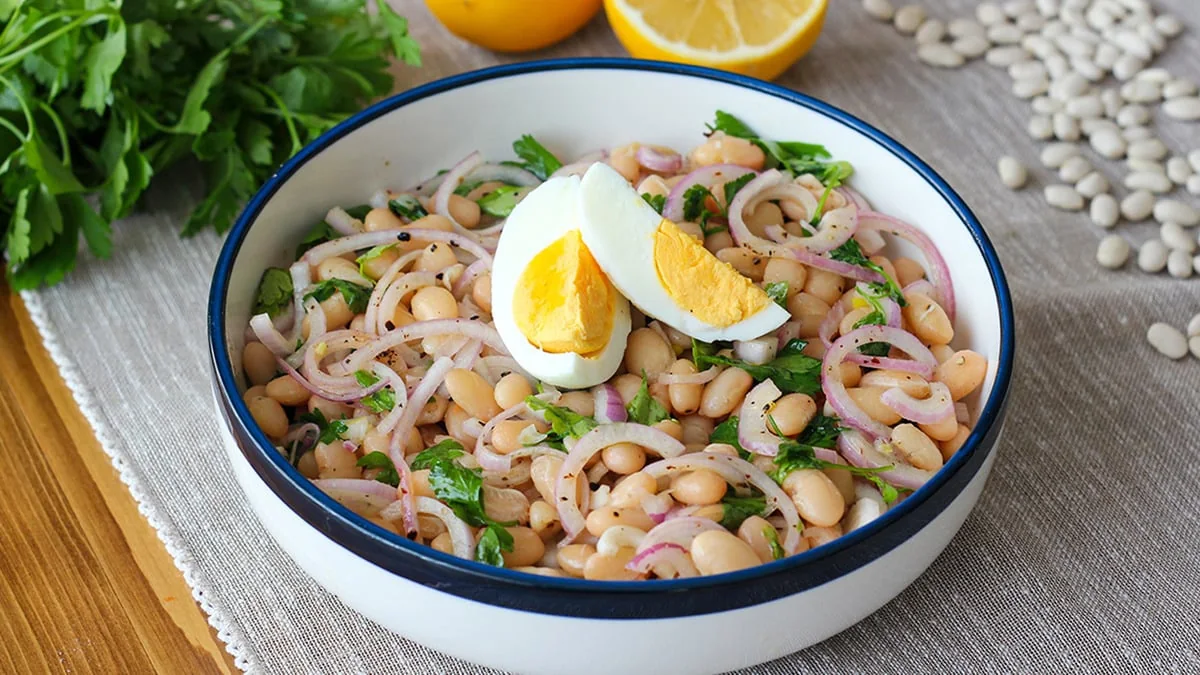
Fibre is also worth eating for its own sake. The NHS recommends 30 g a day for adults, while the average adult gets about 20 g. A food counts as high in fibre on UK labels when it has 6 g or more per 100 g. Beans, lentils, whole grains, vegetables, fruit, nuts and seeds are the best sources. Our article on fibre shows how to reach 30 g, and a bean dish such as piyaz (white bean salad) is about 330 kcal and 40 g carbohydrate per serving in Sporty's per-serving estimates (real values depend on recipe and portion), with much of that from fibre-rich beans.
Do net carbs matter for weight loss?
For most people trying to lose weight, net carbs are a side detail. Weight change follows energy balance: protein and carbohydrate provide 4 kcal per gram and fat 9 kcal per gram. A "2 g net carbs" bar can still contain 200 kcal or more if most of its energy comes from nuts, chocolate coatings or added fat.
| What you track | Most useful for | Watch out for |
|---|---|---|
| Calories | Weight loss, gain or maintenance | Portion sizes, cooking oils, drinks |
| Total carbohydrate | General balance of your diet, sports fuelling | Mixing US and EU label styles |
| Net carbs | Very low-carb or ketogenic diets | Different brand rules, sugar alcohols that are partly absorbed |
Net carbs make most sense if you follow a ketogenic diet, where carbohydrate intake is kept very low and every gram counts. Our guide to the keto diet explains how that works. For everyone else, the quality of carbohydrates matters more than a single number: see carbs explained.
What about diabetes?
People with diabetes, especially those who match insulin doses to carbohydrate, should not switch to counting net carbs on their own. How fibre and different sugar alcohols affect blood glucose varies between people and foods. Ask your diabetes team or a registered dietitian how to handle fibre and sugar alcohols in your carb counting.
The practical takeaway
- Check which label style you are reading before you subtract anything.
- Look at total calories first, then carbohydrate, fibre and sugars.
- Treat front-of-pack "net carbs" claims as marketing until you have checked the panel.
- Get carbohydrate mostly from fibre-rich whole foods rather than specially processed low-carb products.
Sporty shows calories, protein, carbohydrate and fat for each meal you log, so you can see the full picture rather than a single headline number.
Frequently asked questions
How do you calculate net carbs?
Subtract dietary fibre, and sometimes sugar alcohols, from total carbohydrate on a US-style label. On UK or EU-style labels, fibre is usually already listed separately, so you should not subtract it again.
Are net carbs or total carbs better for weight loss?
Neither replaces calories. For weight loss, total energy intake matters most; net carbs are mainly useful on very low-carb or ketogenic diets.
Do sugar alcohols count as carbs?
They are carbohydrates, but most are only partly absorbed. Erythritol is treated as almost calorie-free, while others such as sorbitol and maltitol still provide some energy and can cause digestive discomfort in larger amounts.
Is net carbs an official term?
No. It is not defined in major dietary guidelines, and manufacturers choose their own rules, so net carb figures can differ between brands.
Was this article helpful?
No ratings yet — be the first.
Tap a star to rate it — your rating helps us improve and helps other readers.
Sources
This article is general information, not medical advice. If you have a health condition, are pregnant or under 18, talk to a doctor or registered dietitian before changing your diet.