

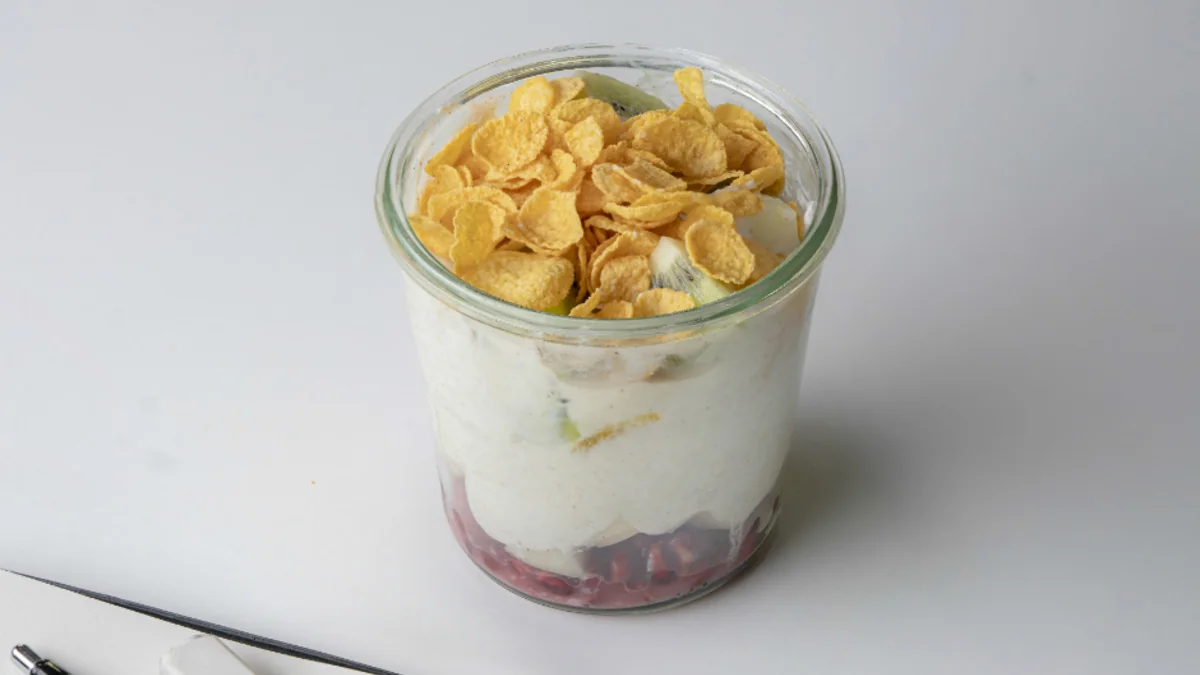
On UK and EU labels, 'light' means at least 30% lower in calories or fat than the brand's standard version, not low overall. 'Low fat' means 3 g of fat or less per 100 g. 'No added sugar' still allows natural sugars from fruit or milk. Always compare the per-100 g figures, not the front-of-pack words.
Key takeaways
- 'Light' or 'lite' only means at least 30% lower in one value, such as calories or fat, than the same brand's standard product.
- 'Low fat' has a fixed meaning: 3 g of fat or less per 100 g of food, or 1.5 g per 100 ml for drinks.
- 'No added sugar' products can still be high in natural sugars from fruit, juice or milk.
- Low-fat and sugar-free products are not automatically low in calories; check energy per 100 g.
- The per-100 g column and the traffic-light colours are the fairest way to compare products.
Why are diet labels so confusing?
Front-of-pack claims are marketing within legal rules: each word has a defined meaning, but rarely the one shoppers assume. "Light" sounds like "low in calories", "low fat" sounds like "good for weight loss", and "no added sugar" sounds like "no sugar". None of those is guaranteed. The numbers on the back of the pack tell you far more.
The definitions below are the ones used on UK and EU labels, as summarised in an NHS hospital dietetics leaflet. Other countries use similar but not identical rules, so the habit that works everywhere is the same: read the nutrition table per 100 g.
What do the most common claims mean?
| Claim | What it means | What it does not mean |
|---|---|---|
| Light / lite | At least 30% lower in one typical value (such as calories or fat) than the manufacturer's standard version | Low in calories or fat overall |
| Low fat | No more than 3 g fat per 100 g (solids) or 1.5 g per 100 ml (liquids) | Low in sugar or calories |
| Reduced fat / reduced sugar | Lower than the standard version of the product | Low by any absolute standard |
| No added sugar / unsweetened | No sugars added as ingredients | Sugar-free: natural sugars from fruit, juice or milk may remain |
| Sugar-free | Contains little or no sugar, often sweetened with sweeteners instead | Calorie-free: fat and starch still count |
"Light" is relative
Because "light" is compared with the brand's own standard product, it can still be high. Imagine crisps with 30 g of fat per 100 g. A light version with 30% less fat would have 21 g per 100 g, which is still above the NHS "high fat" threshold of 17.5 g per 100 g. The NHS leaflet notes that one brand's light crisps may contain about the same fat as another brand's standard ones.
"No added sugar" can still be sweet
A juice drink, fruit bar or flavoured yogurt can carry "no added sugar" while getting its sweetness from fruit juice concentrate or milk sugar. The label should then say it contains naturally occurring sugars. The WHO counts sugars in fruit juices and juice concentrates as free sugars, which it advises keeping below 10% of daily energy, about 50 g a day on 2,000 kcal.
Are low-fat and sugar-free foods lower in calories?
Sometimes, but not always. When fat is removed, manufacturers may add sugar, starch or thickeners to keep the texture and taste, and when sugar is removed, fat may stay the same. Fat has 9 kcal per gram and sugar and starch 4 kcal per gram, so a product can lose fat and gain carbohydrate with only a small change in calories. A sugar-free chocolate or biscuit can be almost as energy-dense as the regular one because most of its calories come from fat and flour.
The fair comparison is energy (kcal) per 100 g, side by side with the standard product. If the difference is small, buy the one you enjoy more and eat a smaller portion.
How do you check a product in 30 seconds?
- Ignore the front claim for a moment. Turn the pack over.
- Read energy per 100 g and compare it with the standard version or a similar product.
- Check the traffic-light thresholds for fat, saturated fat, sugars and salt (below).
- Look at the portion you will actually eat. The per-portion column only helps if your portion matches.
- Scan the ingredients list. Ingredients are listed in order of weight, so sugars or syrups near the top mean the product is mostly sweetened.
| Per 100 g (food) | Low (green) | High (red) |
|---|---|---|
| Fat | 3 g or less | More than 17.5 g |
| Saturated fat | 1.5 g or less | More than 5 g |
| Sugars | 5 g or less | More than 22.5 g |
| Salt | 0.3 g or less | More than 1.5 g |
Values in between are medium (amber). Red does not mean "never": cheese is high in fat but also a good source of protein and calcium. It means "keep an eye on the portion". For a full walk-through of the panel, see how to read a nutrition label.
What about "reference intake" percentages?
Many packs show a portion's contribution as a percentage of the reference intake (RI). These are based on an average adult: 2,000 kcal of energy, 70 g of fat, 20 g of saturates, 90 g of total sugars and 6 g of salt. They are a guide, not a personal target; your own calorie needs may be higher or lower. Sporty sets a personal calorie target from your age, height, weight, activity and goal, which is more useful for day-to-day decisions than a generic 2,000 kcal.
Which other front-of-pack words deserve a second look?
- "Made with wholegrain" or "multigrain". The product may contain only some wholegrain, or several refined grains. Look for wholegrain as the first ingredient.
- "Baked, not fried". Often lower in fat than the fried version, but check the energy per 100 g; some baked snacks are close.
- "High protein". Useful if it fits your day, but a protein bar or pudding can also be high in sugar or fat.
- "Natural" or "with real fruit". These describe ingredients or marketing, not nutrition.
A long ingredients list with many additives is also a sign that a product is heavily processed; our guide to ultra-processed foods explains why that matters.
What about health claims and "diabetic" foods?
Health claims such as "contributes to normal blood cholesterol" must be authorised and based on scientific evidence, and a product cannot claim to treat or cure a disease. Foods marketed as suitable for people with diabetes have not been shown to be healthier than standard versions and are often more expensive. If you have diabetes, your doctor or registered dietitian can tell you what to look for on labels.
So should you buy light products?
They can be useful when the difference is real, for example a lower-fat milk or yogurt, or a reduced-sugar drink. Sweeteners are an option for some people; our guide to artificial sweeteners covers the evidence. But a claim on the front is not a reason to eat more. Compare the numbers, keep the portion in mind, and remember that many of the most filling foods, such as vegetables, pulses, fruit and plain yogurt, carry no claim at all. For more on hidden sugars, see sugar limits and hidden sources.
Frequently asked questions
Does 'light' mean low in calories?
No. On UK and EU labels it means at least 30% lower in calories or fat than the same brand's standard version, which can still be high.
What counts as low fat on a label?
3 g of fat or less per 100 g for foods, or 1.5 g or less per 100 ml for drinks.
Is 'no added sugar' the same as sugar-free?
No. It means no sugars were added as ingredients, but natural sugars from fruit, juice or milk can still be present.
Are sugar-free sweets low in calories?
Not necessarily. Fat and flour still provide calories, so compare energy per 100 g with the regular version.
Was this article helpful?
No ratings yet — be the first.
Tap a star to rate it — your rating helps us improve and helps other readers.
Sources
This article is general information, not medical advice. If you have a health condition, are pregnant or under 18, talk to a doctor or registered dietitian before changing your diet.