

The last 5 kg are slower because a lighter body needs fewer calories and appetite rises: each kilo lost cuts energy needs by about 20–30 kcal a day. Recalculate your target, aim for about 0.25–0.5 kg a week, keep protein high, lift weights and tighten your logging rather than eating very little.
Key takeaways
- Each kg lost lowers daily energy needs by about 20–30 kcal and raises appetite by about 100 kcal (NIH estimate).
- The same meals that gave a 500 kcal deficit at 80 kg may give only about 300 kcal at 65 kg.
- At 0.25–0.5 kg a week, 5 kg takes roughly 10–20 weeks.
- Accurate logging, 1.4–2.0 g/kg of protein and strength training help most near your goal.
- Stay above about 1,200 kcal (women) or 1,500 kcal (men) a day unless a doctor supervises.
Why are the last 5 kg the hardest?
The last few kilos are slower for predictable reasons, not because something is wrong with you. A smaller body needs less energy, so the same meals that once created a clear deficit now create a small one. Appetite tends to rise as weight falls. There is also less room to cut, because intake should not drop below safe minimums. And with less weight to lose, normal day-to-day water swings can hide real progress for weeks.
Researchers at the NIH have estimated that for each kilogram lost, daily energy expenditure falls by about 20–30 kcal, while appetite rises by about 100 kcal a day above where it was before weight loss (Hall and Kahan, 2018). After 15 kg, that is a meaningful push in the wrong direction. This is also why many people reach a plateau after several months.
Do you actually need to lose them?
Before planning, it is worth asking whether the last 5 kg are a health goal or a number you picked years ago. The CDC notes that even a modest loss of 5% of body weight can improve blood pressure, cholesterol and blood sugar. If you have already lost that much, you have kept much of the benefit. Waist size, strength, energy and how your clothes fit can matter as much as the scale; the guide on setting a realistic goal weight walks through this.
If you still want to lose them, that is a reasonable goal. It just calls for a slightly different approach than the first 10 kg.
How much does your calorie target change?
The Mifflin-St Jeor equation estimates resting energy needs from weight, height, age and sex (women: 10 × weight + 6.25 × height − 5 × age − 161). Multiply by an activity factor to get daily needs. Here is a worked example for a 35-year-old woman, 165 cm tall, with a light activity level (factor 1.375):
| Body weight | Resting needs | Daily needs (× 1.375) |
|---|---|---|
| 80 kg | about 1,495 kcal | about 2,055 kcal |
| 70 kg | about 1,395 kcal | about 1,920 kcal |
| 65 kg | about 1,345 kcal | about 1,850 kcal |
At 80 kg, eating about 1,555 kcal a day gave her a deficit of around 500 kcal. At 65 kg, the same 1,555 kcal is only about 300 kcal below her needs, and that is before any rise in appetite or drop in daily movement. Nothing stopped working; the target simply moved. Recalculating every 5 kg or so keeps your plan honest.
Mifflin-St Jeor equation × activity factor. Capped at the usual minimum (1,200 kcal women / 1,500 kcal men); going lower needs medical supervision. Estimates only.
What pace is realistic for the last 5 kg?
Health agencies describe about 0.5–1 kg a week as a safe pace, and closer to your goal the lower end is more realistic. Using the rough rule that 1 kg of body fat holds about 7,700 kcal (an approximation, not an exact figure), here is what different paces require:
| Pace | Daily deficit (approx.) | Time for 5 kg |
|---|---|---|
| 0.25 kg a week | about 275 kcal | about 20 weeks |
| 0.5 kg a week | about 550 kcal | about 10 weeks |
For the woman in the example, a 550 kcal deficit means about 1,300 kcal a day, close to the 1,200 kcal minimum that should not be crossed without medical supervision (1,500 kcal for men). A slower pace of 0.25–0.4 kg a week is often easier to keep, protects muscle better and leaves room for normal life. The NIH Body Weight Planner can model this for your own numbers.
What actually helps with the last few kilos?
Tighten your logging, not your portions
With a small deficit, small errors matter. A tablespoon of cooking oil is about 120 kcal; a few untracked spoonfuls, drinks or weekend snacks can erase a 300 kcal deficit. Before cutting food, log honestly for two weeks: weigh oil, check drinks and include weekends. Often the fix is here.
Keep protein high
The ISSN position stand suggests 1.4–2.0 g of protein per kg of body weight for people who exercise. At 65 kg that is about 91–130 g a day. Protein helps protect muscle in a deficit and is filling, which helps when appetite rises. A lean chicken shish serving brings 46 g for about 380 kcal in Sporty's catalog.
Lift something
Resistance training two or three times a week helps you keep muscle while fat comes off. Close to your goal, it is common for the scale to move slowly while the waist and mirror change; body recomposition explains why.
Move more during the day
Daily steps, taking stairs and walking errands add up without the hunger that hard workouts can bring. They also offset the quiet drop in movement many people notice when dieting.
Sleep and stress
Short sleep tends to make hunger harder to manage. Consistent sleep will not burn fat on its own, but it makes the other habits easier to keep.
What does a day around 1,400 kcal look like?
Here is an example day built from catalog dishes, high in protein and filling enough to stick with. Values are Sporty's per-serving estimates; real values depend on recipe and portion.
| Meal | Dish | Calories | Protein |
|---|---|---|---|
| Breakfast | Oats, yogurt and fruit | 390 kcal | 22 g |
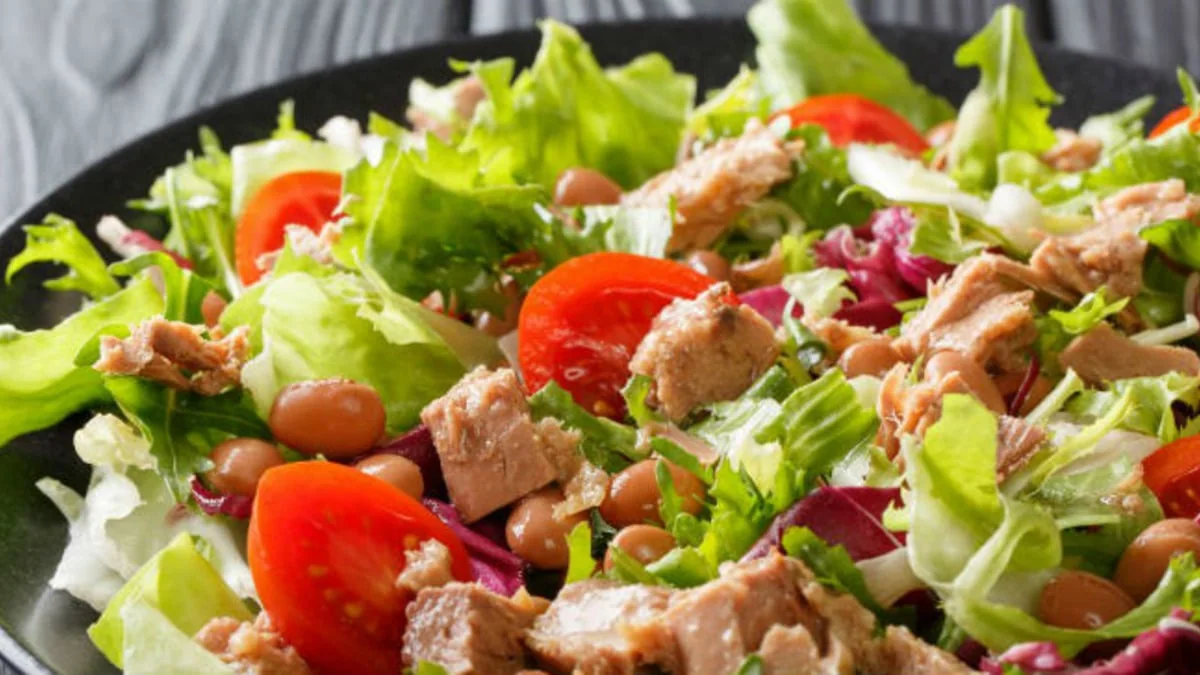
| Lunch | Tuna salad and yogurt | 480 kcal | 52 g |
| Dinner | Chicken shish | 380 kcal | 46 g |
| Side | Shepherd's salad | 160 kcal | 3 g |
| Total | 1,410 kcal | 123 g |
For the 65 kg example, this is a deficit of about 440 kcal and about 1.9 g of protein per kg. A piece of fruit or a yogurt fits in if hunger is high. This is an illustration, not a prescription; your own target depends on your body and activity.
How should you read the scale near your goal?
When you are losing 0.25 kg a week, a salty dinner or a hard workout can shift the scale by more than a week's fat loss. Weigh at the same time each morning and look at the weekly average, not single days. If the average has not moved for three to four weeks while your logging is accurate, adjust intake by 100–200 kcal or add activity. The guide to water weight versus fat loss explains the daily swings.
Is a break from dieting a bad idea?
No. Some people find it easier to spend a few weeks at maintenance, practise eating at their new weight, then return to a deficit. Weight does not have to fall every week for the plan to be working, and learning to maintain is a skill you will need anyway.
This article is general information, not medical advice. Never promise yourself a specific result on a specific date. If you are pregnant, under 18, have a medical condition or a history of disordered eating, talk to a doctor or registered dietitian before changing your diet.
Frequently asked questions
Why is it so hard to lose the last 5 kg?
A lighter body burns less energy and appetite tends to rise as you lose weight, so your original plan creates a smaller deficit. Water swings also hide small changes on the scale.
How long does it take to lose the last 5 kg?
At a sustainable 0.25–0.5 kg a week it usually takes about 10–20 weeks. Progress is rarely linear, so judge it by your weekly average over a month.
Should I eat less to lose the last few kilos?
Recalculate your target first and check your logging. If you do reduce intake, small steps of 100–200 kcal work better than drastic cuts, and you should stay above 1,200 kcal (women) or 1,500 kcal (men) without medical supervision.
Does strength training help with the last kilos?
Yes. It helps you keep muscle while losing fat, so your waist and shape can change even when the scale moves slowly.
Was this article helpful?
No ratings yet — be the first.
Tap a star to rate it — your rating helps us improve and helps other readers.
Sources
This article is general information, not medical advice. If you have a health condition, are pregnant or under 18, talk to a doctor or registered dietitian before changing your diet.