
Barcode scanning pulls a packaged product's nutrition data from its label, which makes it one of the most reliable ways to log food. The weak point is the portion: check that the matched product and version are right, enter what you actually ate in grams or servings, and add anything you mixed in, such as milk or oil.
Key takeaways
- A barcode gives you the label's values; you still have to enter the portion you really ate.
- Labels describe a reference amount, per 100 g or per serving, which is often not your portion.
- Log extras such as milk, oil, butter and sauces separately: one tablespoon of olive oil is about 120 kcal.
- Check dry versus cooked weight, drained weight and the exact product version before saving.
- Consistent, roughly right logging beats perfect logging you give up on.
How does barcode scanning work in a food log?
The barcode on a package is a product code. When you scan it, the app looks up that product and pulls in the nutrition information that comes from its label: energy, protein, carbohydrate, fat and the reference amount those numbers describe. Your job is the part the barcode cannot know, which is how much of the product you actually ate.
In Sporty, barcode scanning sits next to photo, voice and text logging. A good rule of thumb: scan whenever there is a barcode, photograph plates, and type or weigh the calorie-dense extras that neither method sees. Like any entry, a scanned product is worth a quick check of the portion before you save it.
Why is barcode logging usually more reliable than a photo?
A photo estimate has to recognise the food and guess the portion from what the camera sees. A barcode skips the recognition step and uses the manufacturer's declared values. That matters most for products that look alike but differ in nutrition, such as full-fat and low-fat yogurt, regular and sugar-free drinks, or white and wholegrain bread. Our guide to AI photo calorie counting explains where visual estimates struggle and why the methods work best together.
Label values are not perfect either. They are declared values for a typical product, and real items vary a little from batch to batch. For day-to-day logging, though, they are about as good as information gets, so nearly all of the error in a barcode entry comes from the portion and the extras, not from the scan.
What are the most common barcode logging mistakes?
Logging the serving instead of your portion
Labels describe a reference amount. EU and UK labels always give values per 100 g or 100 ml, and sometimes per portion; US labels are built around a serving size. As the NHS puts it, the manufacturer's idea of a portion may be different from yours.
Say a cereal label lists a 40 g serving at 150 kcal and you pour 80 g. If you log one serving, you record 150 kcal; the bowl really holds 300 kcal before you add milk. Weighing your usual bowl once or twice is the quickest fix. Our guide on how to read a nutrition label covers per 100 g versus per serving in more detail.
Forgetting what you added
The barcode describes the product as it leaves the package. It knows nothing about the milk on your cereal, the butter in the pan or the dressing on a bagged salad. Oil is the big one: fat provides 9 kcal per gram, and one tablespoon of olive oil adds roughly 120 kcal and about 14 g of fat (USDA FoodData Central). Add these extras as separate entries.
Mixing up dry and cooked weight
Pasta, rice, oats, lentils and couscous are usually labelled as the dry product. Once cooked they absorb water and weigh a lot more, so 100 g of cooked pasta is not the same as 100 g on the dry-pasta label. Either weigh the food dry before cooking, or log the share of the pack you cooked and the share of the pot you ate.
Ignoring drained weight
Canned tuna, beans, chickpeas and vegetables often list both a net weight and a drained weight. Check which one the nutrition values refer to, and remember that tuna packed in oil keeps some of that oil unless you drain it well.
Accepting the wrong version of a product
The same brand can sell regular, light, flavoured and high-protein versions with very similar packaging, and recipes can differ between countries. Before you save, check that the product name, flavour and pack size on screen match the package in your hand.
Splitting shared packs by eye
For a frozen pizza, a family-size ready meal or a large bag of crisps, log a fraction of the pack instead of guessing. If a pack weighs 400 g and you eat half, that is 200 g. A fraction you can name is far more accurate than a slice you eyeball.
How do you log a packaged product accurately, step by step?
- Scan before you open or cook. The package, with its barcode and label, is still in your hand.
- Check the match. Product name, flavour, version and pack size should match what you bought.
- Choose grams when you can. Weight is the most precise unit. If you do not have a scale, use whole units (one bar, one pot) or a clear fraction of the pack.
- Enter your real portion. Not the label's serving, unless you genuinely ate exactly that.
- Add the extras. Milk, oil, butter, sauces, toppings and drinks, each as its own entry.
- Save, then reuse your knowledge. Once you know your usual bowl of cereal or portion of yogurt, the next scan takes seconds.
What about meals that mix packaged and fresh food?
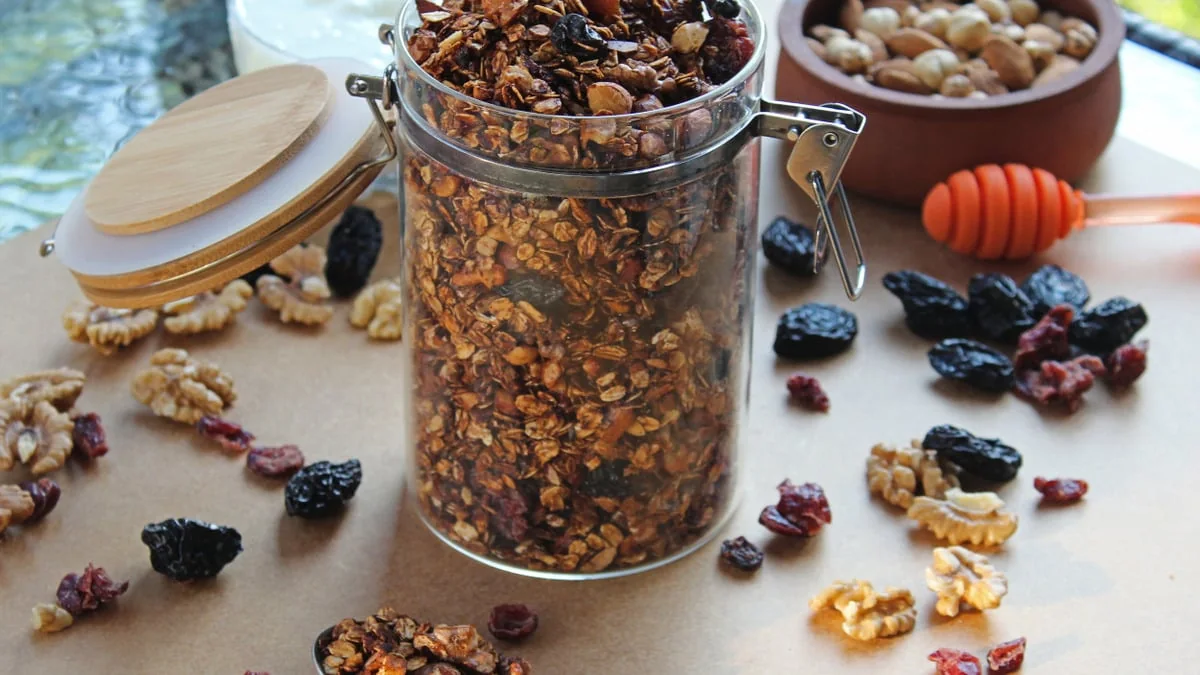
Most real meals are a mix. Take a homemade granola bowl with yogurt, nuts and fruit. Sporty's per-serving estimate for this dish is 420 kcal, 14 g protein, 52 g carbohydrate and 18 g fat, based on 150 g yogurt and 50 g granola; real values depend on the recipe and portion. If you build the same bowl from packaged products, you can log it more precisely piece by piece:
| Component | Best way to log it | What to watch |
|---|---|---|
| Yogurt | Barcode | Full-fat or low-fat version; grams spooned, not the pot size |
| Granola | Barcode | Weigh it once: poured portions are often bigger than the label serving |
| Fresh fruit | Text or photo | Number of pieces or a handful |
| Nuts | Barcode or text | Calorie-dense: count or weigh rather than estimate |
| Honey | Text | Teaspoons, not "a drizzle" |
You can sanity-check any entry from its macros: protein and carbohydrate provide 4 kcal per gram and fat 9 kcal per gram. For the granola bowl, 14 × 4 + 52 × 4 + 18 × 9 = 426 kcal, close to the 420 kcal estimate. Our guide to macros explained shows how these three numbers fit into a day.
How accurate does your food log need to be?
Accurate enough to show a trend, not perfect. Body weight responds to your intake over weeks, so a small random error in one meal matters much less than a mistake you repeat every day. One unlogged tablespoon of oil a day adds up to about 840 kcal a week (120 × 7). That is why the extras and the portion deserve more attention than the scan itself.
If you do not own a scale, hand-based shortcuts work well for most foods; see our guide to portion sizes without a scale. And if tracking ever makes you anxious, or you have a history of disordered eating, it is fine to step back and talk to a doctor or registered dietitian about an approach that suits you.
Frequently asked questions
Is barcode scanning more accurate than photo logging?
For packaged food, usually yes, because it uses the manufacturer's label instead of a visual estimate. The accuracy still depends on entering the portion you actually ate and adding anything you mixed in.
Should I log the serving size printed on the label?
Only if you ate exactly that amount. Weigh your portion or log a clear fraction of the pack, because the label's serving is a reference amount, not a measurement of your bowl.
How do I log pasta or rice from a barcode?
The label usually describes the dry product. Weigh it dry before cooking, or log the share of the pack you cooked and the share of the pot you ate.
What if the scanned product does not match my package?
Do not save a close-but-wrong match, since light, flavoured and regional versions can differ. Log the product by typing its name and amount instead, using the values on its label.
Sources
This article is general information, not medical advice. If you have a health condition, are pregnant or under 18, talk to a doctor or registered dietitian before changing your diet.