
The most budget-friendly protein usually comes from dried lentils, chickpeas and beans, eggs, milk and plain yogurt, canned fish and chicken bought in larger packs. A 500 g bag of dried lentils holds about 123 g of protein. Compare foods by their cost per 10 g of protein, not the price per pack, and build meals around the cheapest.
Key takeaways
- A 500 g bag of dried lentils contains about 123 g of protein, based on USDA data.
- Compare foods by cost per 10 g of protein rather than by the price of the pack.
- Eggs, milk, plain yogurt, canned fish, pulses and chicken are low-cost protein staples almost everywhere.
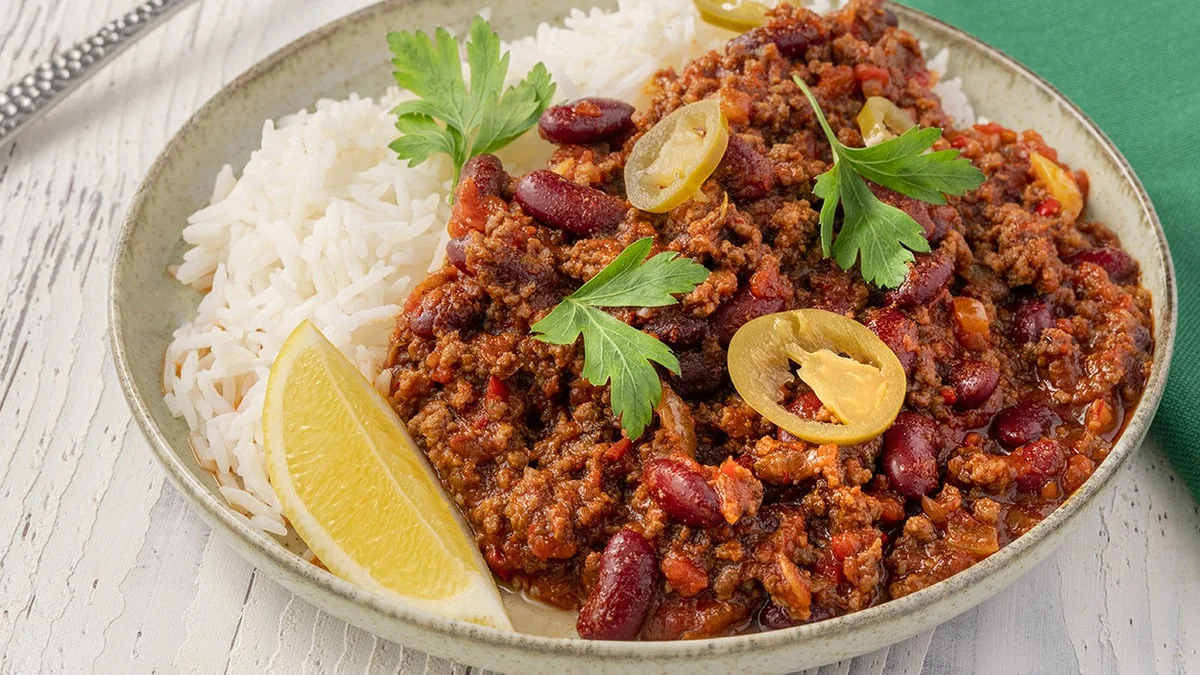
- Mixing pulses into meat dishes stretches both the protein and the budget, as chili con carne shows.
- Adults need at least 0.8 g of protein per kg a day; people who train often aim for 1.4–2.0 g/kg.
How much protein do you actually need?
Before spending money on protein, it helps to know your target. The US National Academies set the Recommended Dietary Allowance (RDA) for adults at 0.8 g of protein per kg of body weight per day, which is 56 g for a 70 kg (154 lb) adult. If you train regularly or want to keep muscle while losing fat, the International Society of Sports Nutrition (ISSN) suggests 1.4–2.0 g/kg, or 98–140 g a day at 70 kg.
Many people reach the RDA without trying. The extra cost appears when you aim higher, and that is where choosing foods carefully pays off. The ISSN also suggests spreading protein across the day in portions of roughly 20–40 g, so you do not need special products, just a reliable protein source at each main meal. Our guide to how much protein you need per day explains the targets in detail. To find your own range:
Daily protein calculator
0.8 g/kg is the adult RDA; 1.4–2.0 g/kg is the ISSN range for people who exercise. Kidney disease needs medical advice.
Which cheap foods give the most protein?
Prices differ widely between countries and shops, so instead of listing prices, the table shows how much protein common low-cost staples deliver per 100 g as bought, based on USDA FoodData Central. Use it together with the prices on your own shelf.
| Food (100 g as bought) | Energy | Protein | Protein per 100 kcal |
|---|---|---|---|
| Dried lentils | 352 kcal | 24.6 g | 7.0 g |
| Dried chickpeas | 378 kcal | 20.5 g | 5.4 g |
| Eggs (about 2 large) | 143 kcal | 12.6 g | 8.8 g |
| Chicken breast, raw, skinless | 120 kcal | 22.5 g | 18.8 g |
| Light tuna canned in water, drained | 116 kcal | 25.5 g | 22.0 g |
| Sardines canned in oil, drained | 208 kcal | 24.6 g | 11.8 g |
| Low-fat (1%) milk | 42 kcal | 3.4 g | 8.0 g |
| Nonfat plain Greek yogurt | 59 kcal | 10.2 g | 17.3 g |
| Frozen green peas | 77 kcal | 5.2 g | 6.8 g |
Two things explain why pulses are a budget favourite. Dried lentils are about a quarter protein by weight, so a 500 g bag holds roughly 123 g of protein, more than two days' worth at the RDA for a 70 kg adult. They also absorb water: based on USDA values for dry and cooked lentils, 100 g of dried lentils cooks up to roughly 270 g. Canned tuna, chicken breast and Greek yogurt lead on protein per calorie, which matters in a calorie deficit, but they are often pricier per kilo. Eggs and milk sit in between on both counts.
How do you compare protein foods by price?
The price on the pack is misleading on its own, because packs differ in size and in protein content. A simple check is the cost per 10 g of protein:
- Find the protein per 100 g on the nutrition label, or in the table above.
- Multiply it by the pack weight in grams and divide by 100. That is the total protein in the pack.
- Divide the pack price by the total protein, then multiply by 10.
For example, a 500 g bag of dried lentils has about 123 g of protein (24.6 × 500 ÷ 100), so dividing its price by 12.3 gives the cost per 10 g of protein. A box of 10 large eggs holds about 63 g of protein, so divide that price by 6.3. Do the same for canned fish, chicken or yogurt and you can see at a glance which option is cheapest where you live. If you are not sure where to find the protein line, see how to read a nutrition label.
What do budget high-protein meals look like?
Here are everyday dishes from around the world built on low-cost staples, with Sporty's per-serving estimates. Real values depend on recipe and portion.
| Dish (one serving) | Main protein | Energy | Protein | Protein per 100 kcal |
|---|---|---|---|---|
| Chili con carne | Beef and kidney beans | 480 kcal | 34 g | 7.1 g |
| Vegetable omelette | 3 eggs | 320 kcal | 22 g | 6.9 g |
| Chicken and rice | Chicken breast | 520 kcal | 34 g | 6.5 g |
| White bean stew with beef | Beans and beef | 450 kcal | 28 g | 6.2 g |
| Tuna pasta | Canned tuna | 540 kcal | 32 g | 5.9 g |
| Oats, yogurt and fruit | Yogurt and oats | 390 kcal | 22 g | 5.6 g |
| Red lentil soup | Red lentils | 250 kcal | 13 g | 5.2 g |
| Lentil salad | Green lentils | 320 kcal | 16 g | 5.0 g |
| Chickpea stew | Chickpeas | 360 kcal | 16 g | 4.4 g |
Chili con carne is a good model for budget cooking: kidney beans stretch a modest amount of beef into a filling, high-protein meal. Pure pulse dishes such as a red lentil soup are lower in protein per serving, so pair them with an egg, a pot of yogurt or a glass of milk to bring the meal above 20 g.
How can you stretch your protein budget?
- Cook pulses in batches. One pot of lentils or beans covers several meals, and cooked pulses freeze well in portions.
- Mix pulses into meat dishes. Replacing part of the minced meat in a bolognese, chili or meatballs with lentils keeps protein and fibre up while using less meat.
- Make eggs a default. A large egg gives about 6 g of protein for about 72 kcal; our guide on how many eggs to eat covers the details.
- Choose plain dairy in large containers. Plain yogurt and milk are usually cheaper per kilo than flavoured single pots and contain no added sugar.
- Keep canned fish in the cupboard. Tuna and sardines need no cooking and keep for a long time.
- Buy chicken in larger packs and freeze it in meal-sized portions.
- Use frozen peas and vegetables. They add some protein and fibre, last for months and cut food waste.
Do you need protein powder on a budget?
No. Protein powder is a convenience, not a requirement. In some places it can be reasonably priced per 10 g of protein, so it is worth running through the same calculation, but whole foods also bring fibre, vitamins and minerals. If your target is close to the RDA, ordinary meals built around the foods above usually cover it. For meat-free options, see getting enough protein without meat.
What does a low-cost, high-protein day look like?
Here is one example day using the dishes above and two hard-boiled eggs (USDA values). It is an illustration, not a meal plan.
| Meal | Food | Energy | Protein |
|---|---|---|---|
| Breakfast | Oats, yogurt and fruit | 390 kcal | 22 g |
| Lunch | Tuna pasta | 540 kcal | 32 g |
| Snack | 2 hard-boiled eggs | 155 kcal | 13 g |
| Dinner | Chili con carne | 480 kcal | 34 g |
| Total | about 1,565 kcal | 101 g |
For a 70 kg adult, that is about 1.4 g/kg, the bottom of the ISSN range, from foods found in most supermarkets. Add fruit, vegetables, bread or snacks to match your own calorie needs. Logging a few ordinary days, for example by describing your meals in Sporty, shows quickly whether you are already near your target before you spend more on protein.
If you have kidney disease, are pregnant or breastfeeding, are under 18 or have a history of disordered eating, talk to a doctor or registered dietitian before raising your protein intake.
Frequently asked questions
What is the cheapest source of protein?
It depends on local prices, but dried lentils, beans and chickpeas, eggs and milk are usually among the cheapest. Work out the cost per 10 g of protein for the foods in your shop to compare them fairly.
Is canned tuna a good budget protein?
Yes. Light tuna canned in water has about 25.5 g of protein per 100 g drained for 116 kcal, according to USDA data, and needs no cooking.
Can you get enough protein without buying meat?
Yes. Pulses, eggs, dairy and soy foods can cover most targets. Including a protein-rich food at every main meal makes it easier.
How many eggs give 20 g of protein?
A large egg has about 6 g of protein, so three large eggs give about 19 g. Adding a glass of milk or a pot of yogurt takes the meal above 20 g.
Sources
This article is general information, not medical advice. If you have a health condition, are pregnant or under 18, talk to a doctor or registered dietitian before changing your diet.