
You cannot burn fat from one spot. In a six-week trial, daily ab exercises made abdominal muscles stronger but did not reduce belly fat or waist size. Belly fat goes down with overall fat loss: a moderate calorie deficit, regular aerobic activity, whole-body strength training, enough protein and patience over months.
Key takeaways
- Spot reduction is not supported: six weeks of ab exercises did not shrink belly fat in a trial.
- Belly fat falls with overall fat loss from a moderate calorie deficit.
- Moderate to vigorous aerobic exercise is linked to less visceral fat.
- The WHO recommends 150–300 minutes of moderate activity a week plus strength training.
- The NHS suggests keeping your waist under half your height as a rough check.
Can you burn belly fat by training your abs?
It is one of the most common hopes in fitness: do enough crunches and the fat on your stomach will disappear. The research does not back it up. In a 2011 randomised trial, 24 healthy, sedentary adults were split into two groups. One group did seven abdominal exercises, two sets of ten repetitions, five days a week for six weeks, while everyone kept their calorie intake steady. At the end, the exercise group had clearly better abdominal endurance, but compared with the group that did nothing there was no significant change in body weight, body fat percentage, abdominal fat, waist circumference or skinfold measurements.
That is the idea known as "spot reduction": that working a muscle burns the fat lying directly over it. Your abs do get stronger when you train them, which is useful in its own right. The fat on top, however, is drawn on as part of your whole body's energy balance, not by the muscle underneath. The study was small and short, so it is not the final word, but it fits the wider picture: there is no reliable evidence that you can choose where you lose fat.
Why does belly fat matter for health?
Bodies come in many shapes, and a soft stomach is not a flaw or something to feel ashamed of. The health interest is mainly in the fat stored deeper inside the abdomen, around the organs, called visceral fat. Researchers link larger amounts of it with metabolic problems, which is why doctors look at waist size and not only at the number on the scale.
The NHS suggests a simple check: try to keep your waist measurement to less than half your height. For someone who is 170 cm tall, that means a waist under 85 cm. It is a rough screening tool, not a diagnosis, and it says nothing about your worth as a person. If your waist is more than half your height and your BMI is in the overweight range, the NHS advises speaking to a GP.
What actually reduces belly fat?
The approaches that work are less exciting than a targeted exercise, but they are backed by evidence:
- An overall calorie deficit. Fat comes off the whole body when you take in less energy than you use. The NHS puts the core principle plainly: eat and drink fewer calories than your body uses. Our guide to the calorie deficit explains how to set one without going too low.
- Regular aerobic activity. A 2013 systematic review and meta-analysis found that aerobic exercise of moderate or high intensity had the most potential to reduce visceral fat in adults with overweight, even without a calorie-restricted diet, with benefits seen after about 12 weeks.
- Strength training for the whole body. It will not burn the fat over one particular muscle, but the WHO recommends regular muscle-strengthening activity for all adults, and keeping muscle while you lose fat matters for strength and everyday function.
- Enough protein. Protein helps you hold on to muscle in a deficit and makes meals more filling. See how much protein you need per day.
- Patience. Where your body loses fat first differs from person to person. Many people notice changes at the waist later than elsewhere, so judge progress over months, not days.
How much activity should you aim for?
The WHO 2020 guidelines recommend that all adults do 150–300 minutes of moderate-intensity activity a week, or 75–150 minutes of vigorous-intensity activity, or an equivalent mix of both, together with regular muscle-strengthening activity. They also stress that some activity is better than none and that cutting down on time spent sitting helps.
| Approach | What it does | Shrinks belly fat on its own? |
|---|---|---|
| Crunches and sit-ups | Stronger abdominal muscles with more endurance | No good evidence that it does |
| Brisk walking, cycling, swimming | Uses energy; linked to less visceral fat in studies | Helps, works best alongside a deficit |
| Whole-body strength training | Keeps or builds muscle | Indirectly, as part of overall fat loss |
| A moderate calorie deficit | Lowers total body fat, including around the waist | Yes, over time |
For many people, walking is the easiest place to start. Our article on how many steps a day help with weight loss shows how to build up gradually.
How fast can belly fat go down?
There is no separate timeline for the stomach; it follows your overall fat loss. A typical safe pace is about 0.5–1 kg (1–2 lb) per week. As a rough rule, about 7,700 kcal corresponds to 1 kg of body fat, so a deficit of 500 kcal a day adds up to 3,500 kcal a week, or roughly 0.45 kg. The rule is only approximate, because water, muscle and changes in your energy use all shift the result.
Even a modest loss counts. The NHS notes that losing 5–10 % of your body weight can improve your health; for someone weighing 90 kg, that is 4.5–9 kg. Your waist may shrink before the scale moves much, especially if you have started strength training, so a tape measure is a useful second signal. If the scale jumps around from day to day, our guide to water weight versus fat loss explains why.
What does a day of eating for fat loss look like?
There is no "belly fat food" and no food that works on the stomach specifically. What helps is a pattern that keeps you in a moderate deficit while staying full: lean protein, plenty of vegetables, fibre-rich carbohydrates and measured amounts of oil. A few examples from our meal catalog, as Sporty's per-serving estimates (real values depend on recipe and portion):
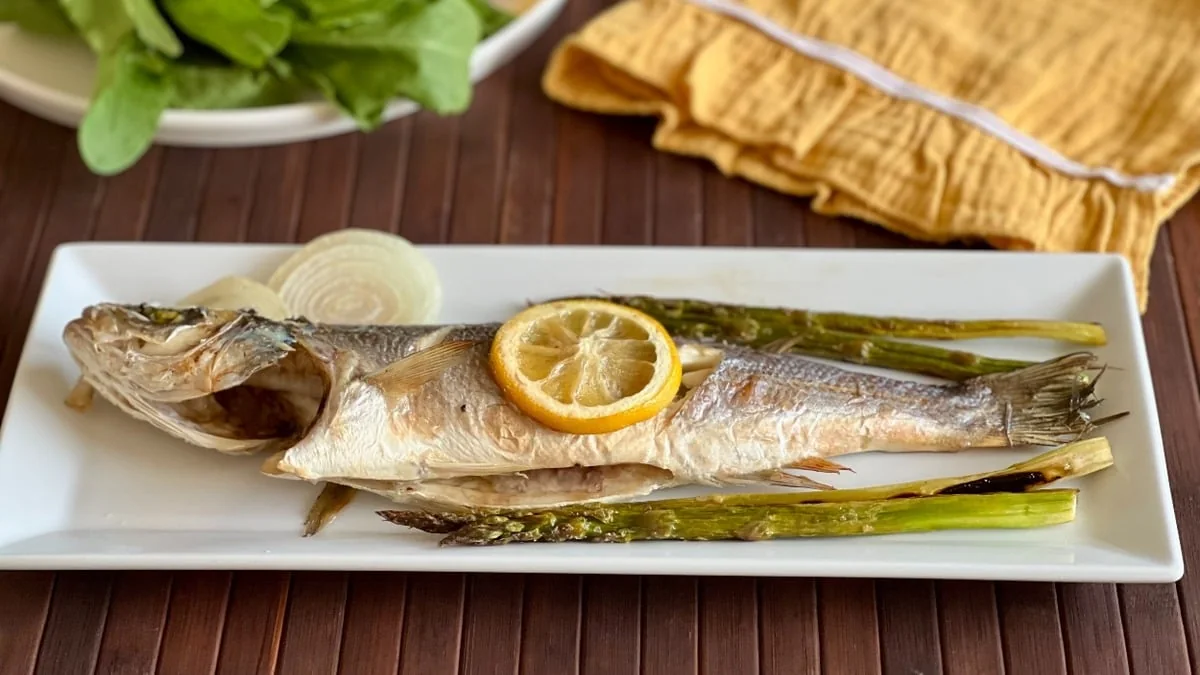
- Grilled fish and vegetables: 450 kcal and 48 g of protein, with a 200 g fillet, asparagus and courgette.
- Chicken shish: 380 kcal and 46 g of protein.
- Red lentil soup: 250 kcal and 13 g of protein, a filling starter or light lunch.
- Greek salad: 290 kcal and 9 g of protein; feta and olive oil provide most of the energy.
Drinks are worth a look too. Alcohol provides 7 kcal per gram and is easy to overlook. Logging what you eat for a couple of weeks, for example by photographing your meals in Sporty, can show where your calories actually come from.
Which belly fat claims can you ignore?
- Fat-burning teas, pills and waist wraps. None of them can decide where fat is lost. Sweating under a wrap loses water, which comes back as soon as you drink.
- "Flat belly" foods. No single food removes fat from one area. The overall pattern of what you eat is what counts.
- Hundreds of crunches a day. They build endurance, as the 2011 trial showed, but not a smaller waist on their own.
- Crash diets. Women should not go below about 1,200 kcal a day and men below about 1,500 kcal a day without medical supervision. Faster is not better in the long run.
When should you talk to a doctor?
See a doctor if your waist is growing quickly without an obvious reason, if you have ongoing bloating or pain, or if your waist is more than half your height and you have other risk factors such as high blood pressure. Talk to a doctor or registered dietitian before changing your diet if you are pregnant, under 18, have a medical condition or have a history of disordered eating.
Frequently asked questions
Do crunches burn belly fat?
Not on their own. In a six-week randomised trial, ab exercises improved abdominal endurance but did not change belly fat or waist size compared with a control group.
What is the fastest way to lose belly fat?
There is no shortcut that targets the stomach. A moderate calorie deficit with regular activity is the most reliable approach, and a safe pace of overall loss is about 0.5–1 kg per week.
Which exercise is best for belly fat?
Research links moderate to vigorous aerobic exercise, such as brisk walking, cycling or swimming, with reductions in visceral fat. Adding whole-body strength training helps you keep muscle while you lose fat.
How do I know if my belly fat is a health risk?
The NHS suggests keeping your waist to less than half your height. If it is higher and your BMI is in the overweight range, speak to a doctor for a proper assessment.
Sources
- Vispute et al. 2011, The effect of abdominal exercise on abdominal fat (randomised trial, 24 adults, J Strength Cond Res)
- Vissers et al. 2013, The effect of exercise on visceral adipose tissue in overweight adults: systematic review and meta-analysis (PLoS One)
- Bull et al. 2020, World Health Organization 2020 guidelines on physical activity and sedentary behaviour (Br J Sports Med)
- NHS, Obesity
- CDC, Losing weight
This article is general information, not medical advice. If you have a health condition, are pregnant or under 18, talk to a doctor or registered dietitian before changing your diet.